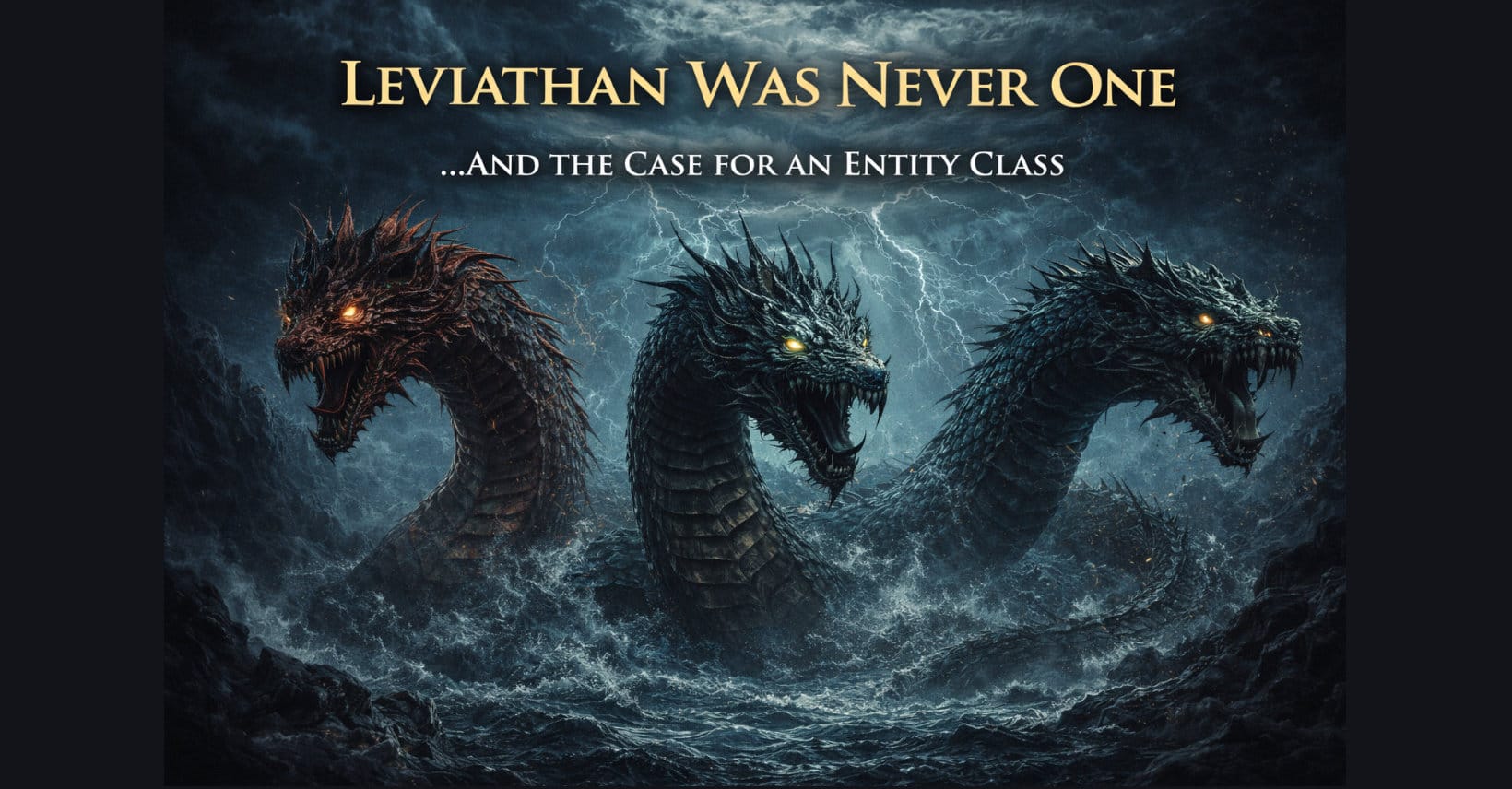
The article argues that Leviathan may be better understood as a category than as a single creature. It points to repeated biblical and cross-cultural traits, including serpentine form, association with the deep, structural complexity, and resistance to authority.
It suggests that ancient language may use one name for a recurring type, while preserving theological claims that Leviathan remains created, subordinate, and subject to judgment. The piece then turns toward the question of why modern interpretation has largely reduced this pattern to symbolism.
Up to this point, the series has followed a disciplined path.
Description before interpretation.
Pattern before conclusion.
From the Book of Job to cross-cultural parallels, the same elements have repeated:
- Serpentine form
- Association with the deep
- Structural complexity
- Opposition to authority
- Placement in inaccessible domains
Now, a new question emerges.
Not what is Leviathan…
…but what kind of category does Leviathan belong to?
The Limits of a Singular Interpretation
The traditional reading assumes Leviathan is a singular creature.
But that assumption encounters friction at multiple points:
- In the Book of Psalms, Leviathan has “heads”
- In the Book of Isaiah, it is described using multiple classifications
- Across cultures, similar entities appear under different names
Taken together, these details resist a simple, singular model.
They suggest something broader.
Singular Name, Expanding Structure
Ancient language often compresses categories into singular terms.
A single name can represent:
- A class
- A type
- A recurring form
This is not unusual.
It is a limitation of vocabulary.
If multiple entities share similar characteristics, they may be described under one conceptual label.
That possibility reframes the discussion.
From Creature to Category
If Leviathan is not a single being, but a category, several observations align more naturally:
- Multiple “heads” may reflect multiple instances, not a single anatomy
- Cross-cultural parallels may reflect encounters with similar entities
- Variations in description may reflect different perspectives of the same category
This does not require uniformity.
It allows for variation within structure.
A Pattern of Consistency
Across all examined sources, the following characteristics persist:
- Serpentine or dragon-like form
- Association with the deep or unseen
- Resistance to human control
- Interaction with higher authority
These are not traits of a single isolated description.
They are traits of a recurring type.
Classification Without Modern Terms
Ancient writers did not have scientific taxonomy.
They described what they encountered using:
- Form (serpent, dragon)
- Behavior (crooked, piercing)
- Domain (sea, deep, underworld)
When these elements repeat across texts, they begin to function as a classification system—informal, but consistent.
The Role of Perspective
Different cultures may have encountered:
- The same phenomenon
- Similar phenomena
- Or interpreted shared experiences differently
This would explain:
- Variation in detail
- Consistency in structure
- Differences in narrative framing
The category remains stable.
The interpretation varies.
Scripture’s Position Within the Category
Within the biblical framework, Leviathan is still:
- A created being
- Under divine authority
- Subject to future judgment
Even if understood as a category, this theological positioning remains intact.
The classification does not elevate the entity.
It clarifies its role.
A Controlled Expansion
It is important to remain precise here.
This is not a claim that Leviathan is a class of entities.
It is an observation that the data allows for that interpretation.
And in some respects, it explains the pattern more effectively than a strictly singular model.
Why This Matters
If Leviathan represents a category rather than an individual, it changes the nature of the inquiry:
- From identifying a creature
- To understanding a type
It shifts the focus from:
“What is it?”
To:
“What defines it?”
That is a more rigorous question.
Where the Inquiry Leads Next
If Leviathan can be understood as a category…
Then the final question becomes inevitable:
Why would such a category be consistently described across civilizations… and then largely reduced to symbolism in modern interpretation?
In the next article, the focus shifts to interpretation itself—
Not ancient description…
…but modern dismissal.
Because the final layer of the pattern may not be in the texts at all…
…but in how we’ve chosen to read them.