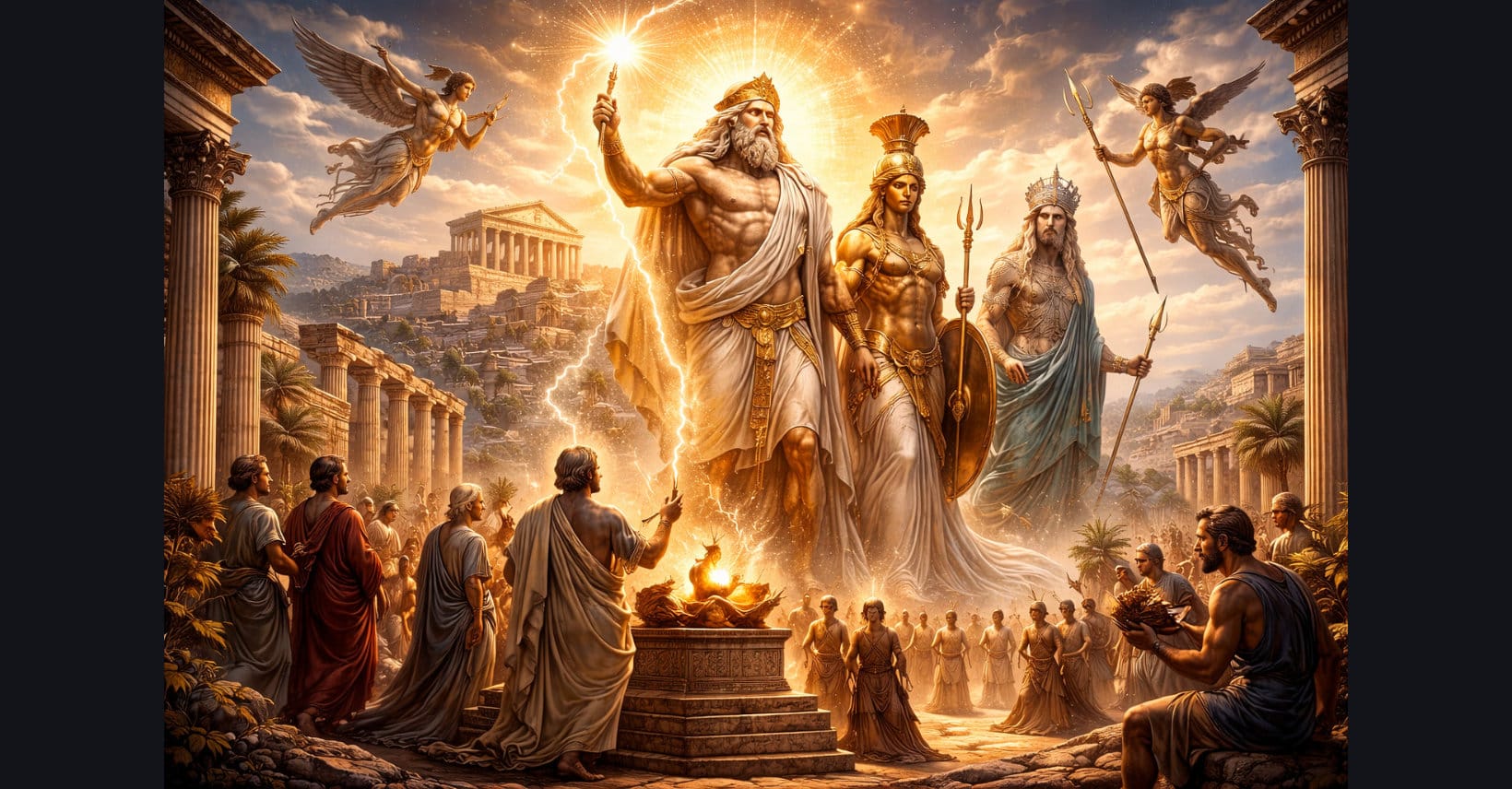
The piece argues that Greek mythology normalized the idea of gods or non-human beings appearing among humans, taking human form, intervening in events, and influencing people directly. It emphasizes the anthropomorphic nature of Greek gods and the way this familiarity made extraordinary encounters seem plausible rather than alarming.
It also connects myths such as Prometheus to themes of knowledge coming from beyond humanity and suggests that later reinterpretations of these stories could be read as advanced beings rather than deities. The post ends by questioning how people would respond to similar phenomena today and whether they would recognize them accurately.
Ancient Greece did something distinct.
It brought the gods down.
Not symbolically. Not abstractly.
But personally.
The gods of Greece were not distant creators operating beyond human reach. They were present, visible, and involved—walking among men, intervening in conflicts, forming alliances, and at times, behaving with motives that looked remarkably human.
This was not simply a belief system.
It was a normalization.
The Human Shape of the Divine
Greek mythology is marked by its anthropomorphic nature.
Gods like Zeus, Athena, Apollo, and Hermes were not described as incomprehensible forces. They had personalities, emotions, preferences, and agendas.
They argued.
They competed.
They intervened.
And perhaps most significantly, they interacted directly with humanity.
They appeared in human form.
They influenced outcomes in war.
They formed relationships with individuals.
In many accounts, the line between divine and human was not clearly defined.
It was permeable.
Familiarity as Acceptance
This is where the Greek worldview introduces a subtle but powerful shift.
The supernatural was not feared as something wholly other.
It was familiar.
When something becomes familiar, it becomes acceptable.
And when it becomes acceptable, it is rarely questioned.
From the perspective developed throughout The Alien Deception Chronicles, this is one of the most effective conditions for misinterpretation.
Not hostility toward the unknown.
Comfort with it.
Because if humanity becomes accustomed to the idea that non-human intelligences can:
- Walk among us
- Speak with us
- Guide or influence us
Then the threshold for skepticism lowers.
What once required proof…
now requires only recognition.
The Gift of Knowledge
One of the most enduring Greek myths is that of Prometheus.
He gives fire to humanity—often interpreted as the gift of knowledge, technology, or advancement.
This theme appears across civilizations:
Human progress attributed to intervention from beyond.
It is a compelling idea.
Because it places humanity not as the originator of its own advancement, but as the recipient of it.
And once again, the implication follows:
If knowledge comes from beyond,
then authority may also come from beyond.
This is not merely a mythological theme.
It is a framework.
The Blurring of Boundaries
Greek mythology frequently explores relationships between gods and humans—sometimes resulting in figures that exist between both worlds.
These accounts further erode the boundary between human and non-human.
They suggest continuity rather than separation.
Connection rather than distinction.
From a biblical standpoint, this is where discernment becomes essential.
Scripture maintains a clear distinction between Creator and creation, between humanity and spiritual beings.
That boundary is not fluid.
It is intentional.
The Greek model presents a world where that boundary is routinely crossed—and often celebrated.
The Reinterpretation in Modern Thought
Today, Greek mythology is generally categorized as symbolic or literary.
But as with other ancient traditions, there is a growing tendency to reinterpret these accounts through a different lens.
The gods become advanced beings.
Their appearances become visitations.
Their interventions become influence.
The structure remains.
Only the explanation changes.
And once again, the conclusion shifts:
Humanity is not alone.
Humanity is influenced.
Humanity may be guided.
Whether framed as divine or extraterrestrial, the effect is the same.
The Role of Expectation
The more a culture accepts a framework, the more it shapes expectation.
In ancient Greece, the idea that gods could appear in human form was not extraordinary.
It was plausible.
Expected.
That expectation matters.
Because when something is expected, it is more easily accepted when it appears.
Not tested.
Accepted.
This is one of the recurring concerns explored throughout The Alien Deception Chronicles:
That humanity may be conditioned—over time—to accept certain interpretations of extraordinary events before those events ever occur.
A Modern Reflection
If something appeared today—something capable of:
- Taking on human form
- Demonstrating knowledge beyond current capability
- Interacting directly with individuals or leaders
Would it be rejected?
Or would it be recognized?
And if recognized… recognized as what?
That answer would not be formed in the moment.
It would be drawn from patterns already embedded in human thought.
Patterns that can be traced back to civilizations like Greece.
A Personal Reflection
What stands out most in the Greek tradition is not the power of the gods.
It is their proximity.
They were not distant.
They were near.
And in that nearness, something shifted.
The supernatural became part of the expected order.
Not something to question.
Something to accept.
That is where the real risk emerges.
Because the closer something appears…
the less likely it is to be examined.
And the less it is examined…
the more easily it can be misunderstood.
The question is not whether humanity will encounter something beyond itself.
History suggests it always has.
The question is whether, when it does,
it will recognize the difference between presence…
and truth.