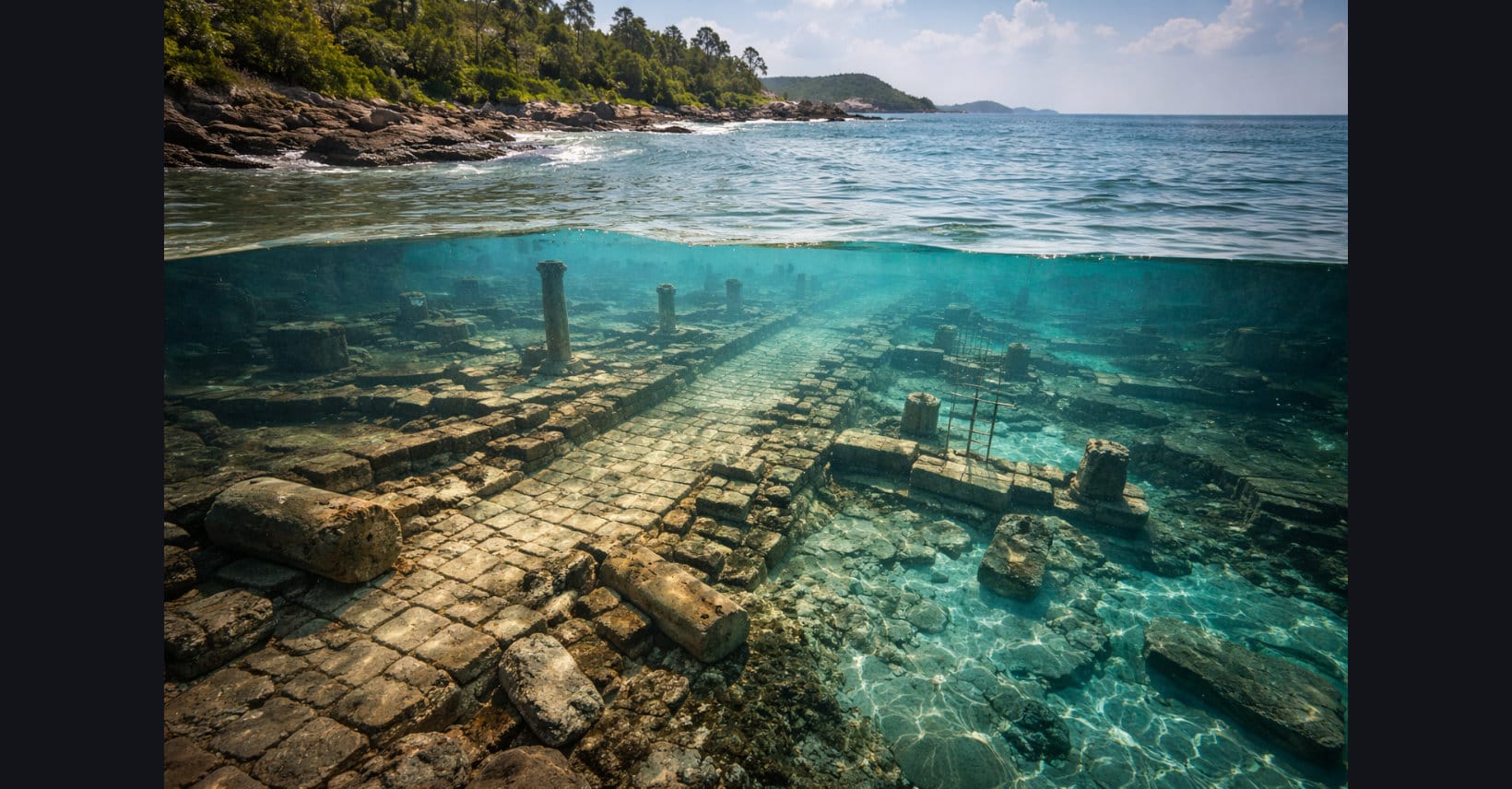
Reports describe possible submerged remains of an ancient city off India’s western coast, including stone roads, foundations, and architectural traces. The find has prompted discussion about South Asian urban history and its possible links to broader prehistoric cultural networks.
The post also frames the discovery as evidence of lost knowledge and unresolved questions about ancient societies. It connects submerged cities to flood myths, sea-level rise, and debates over whether early civilizations possessed capabilities not yet understood.
Recent reports from the Indian Ocean’s littoral waters have shaken the global archaeological community: what may be the remnants of a lost ancient city — stone roads, foundations, and architectural vestiges — have been identified beneath the waters off India’s western shoreline. This discovery, which has rapidly circulated through science and news outlets, promises to rewrite our understanding of ancient urbanism in South Asia and its connections to broader prehistoric cultural networks.
At first glance, the find appears to be a remarkable chapter in human history — yet when viewed through the lens of The Alien Deception Chronicles, deeper questions emerge. Submerged cities are not only archaeological curiosities but also symbolic nodes in the stories we tell about ancient knowledge lost to time. Lost metropolises such as these echo the great flood narratives of many cultures, potentially reflecting collective memory of sea‑level rise at the end of the last Ice Age. But beyond myth, they also invite speculation: what technologies enabled such large, sophisticated settlements to flourish in environments now claimed by the sea?
Like Göbekli Tepe or Malta’s mysterious temples, structures predating conventional timelines challenge the neat progression of historical development — raising the unsettling, provocative question of whether ancient human societies had capabilities we do not yet fully grasp. Even more, such discoveries naturally align with public fascination around lost civilizations, ancient high‑technology, and whether human history contains chapters that have been forgotten or suppressed.
For a Chronicle committed to questioning the official narrative, this underwater city is not just a new archaeological site — it is a mirror reflecting the limits of modern understanding. It asks: are we uncovering isolated events in human history, or are these the ruins of forgotten epochs where native human ingenuity intersected with capacities we cannot yet explain?
In either case, as research continues and more detailed surveys emerge, this find could become a cornerstone for narratives bridging human antiquity and seismic paradigm shifts in how we conceptualize ancient civilizations and their place in the cosmic story.