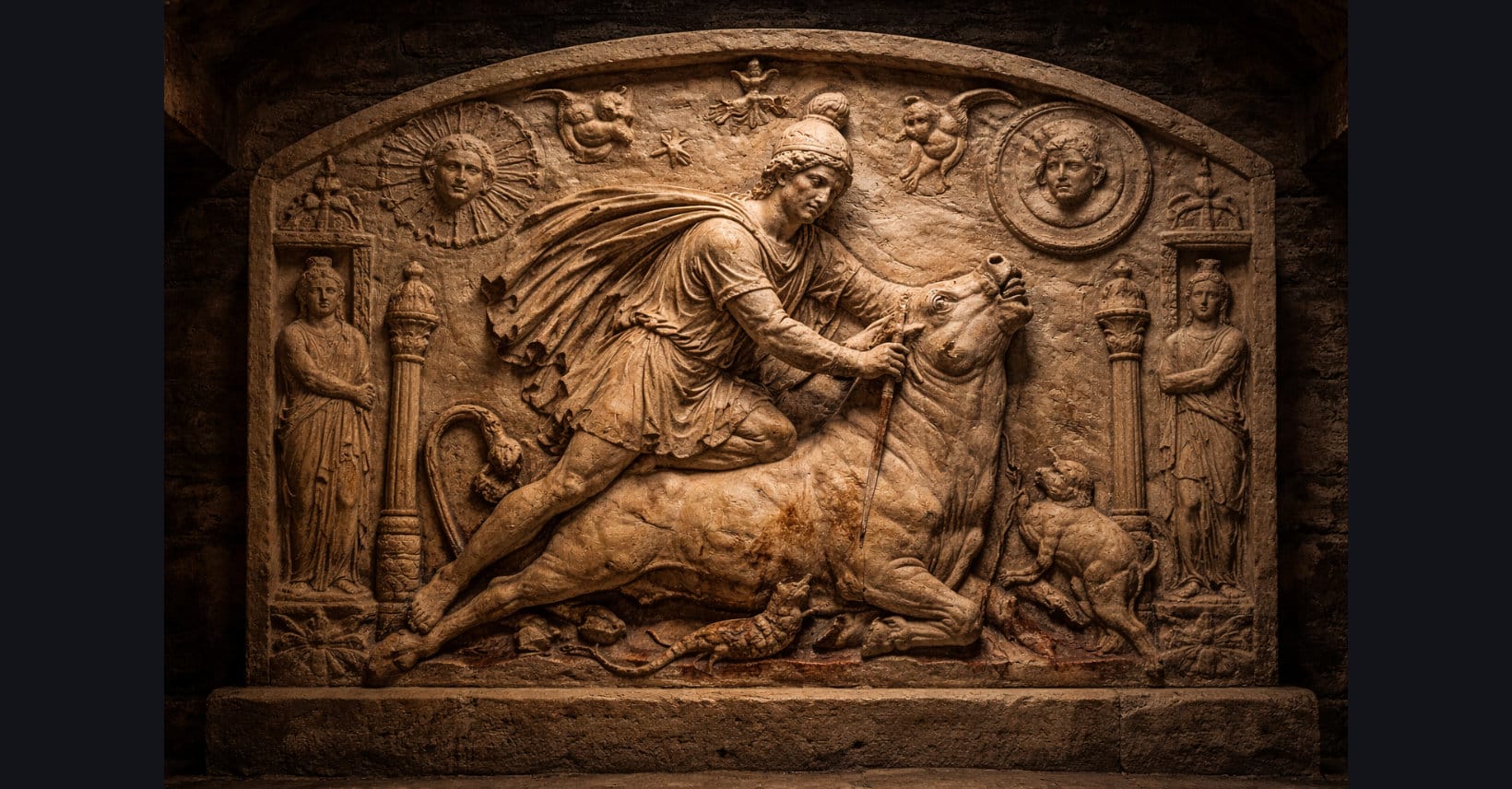
Archaeological findings in Bavaria have uncovered a Roman Mithraeum, adding evidence for the private mystery cult of Mithras within the empire. The text describes how the cult used underground spaces, restricted access, and graded initiation to control religious knowledge.
It argues that Mithraism spread through Roman military and administrative networks and illustrates a broader pattern of layered, compartmentalized understanding in powerful institutions. The discovery is presented as evidence of a structured system of belief operating beneath Rome’s public religion.
Mithras and the Architecture of Initiated Knowledge
Beneath the visible machinery of the Roman Empire—its roads, legions, amphitheaters, and administrative law—another structure operated quietly: a religion designed not for the masses, but for the initiated. Recent archaeological work in Bavaria has uncovered the remains of a Roman Mithraeum, a temple dedicated to the mystery cult of Mithras, offering fresh insight into how deeply stratified knowledge systems functioned inside the empire.
Unlike public Roman worship, which was civic and visible, the cult of Mithras was intentionally private. Temples were constructed underground or in windowless chambers. Entry was restricted. Ritual progression occurred through graded initiation levels, each conferring new symbolic understanding. The architecture itself enforced the system: narrow corridors, controlled lighting, raised platforms, and a central relief depicting Mithras slaying the cosmic bull—a scene dense with encoded astronomical symbolism.
This was not religion as spectacle. It was religion as sequence.
The Bavarian discovery reinforces what earlier finds across Europe suggested: Mithraic worship was widely distributed among Roman military and administrative elites. It was structured, repeatable, and portable across provinces. Wherever imperial infrastructure extended, Mithraea followed—quietly embedded beneath forts and cities.
What makes this discovery relevant beyond archaeology is the organizational model it reveals. Mithraism operated on graduated disclosure. An initiate did not receive the full system at once. Understanding was released in stages. Symbols were interpreted progressively. Meaning deepened with rank.
In The Alien Deception Chronicles, this pattern matters. The framework does not rely on overt manifestations but on structured revelation. Across history, powerful institutions have controlled access to layered knowledge—political, religious, strategic. Public doctrine stabilizes society. Inner doctrine guides the initiated.
The Mithraeum is physical evidence of this design.
Its rediscovery does not suggest extraterrestrial origins. It suggests something equally enduring: humanity has long organized belief around controlled thresholds of understanding. Information has often been compartmentalized not to conceal its existence, but to regulate its interpretation.
Rome’s empire was visible above ground.
Its mystery systems operated below.
And as archaeology continues to uncover subterranean chambers across Europe, it reminds us that parallel structures of meaning have always existed beneath official narratives.
The hidden religion beneath Rome’s empire was not marginal. It was structural.
And like many buried systems, it endured long after its public counterpart faded from dominance.