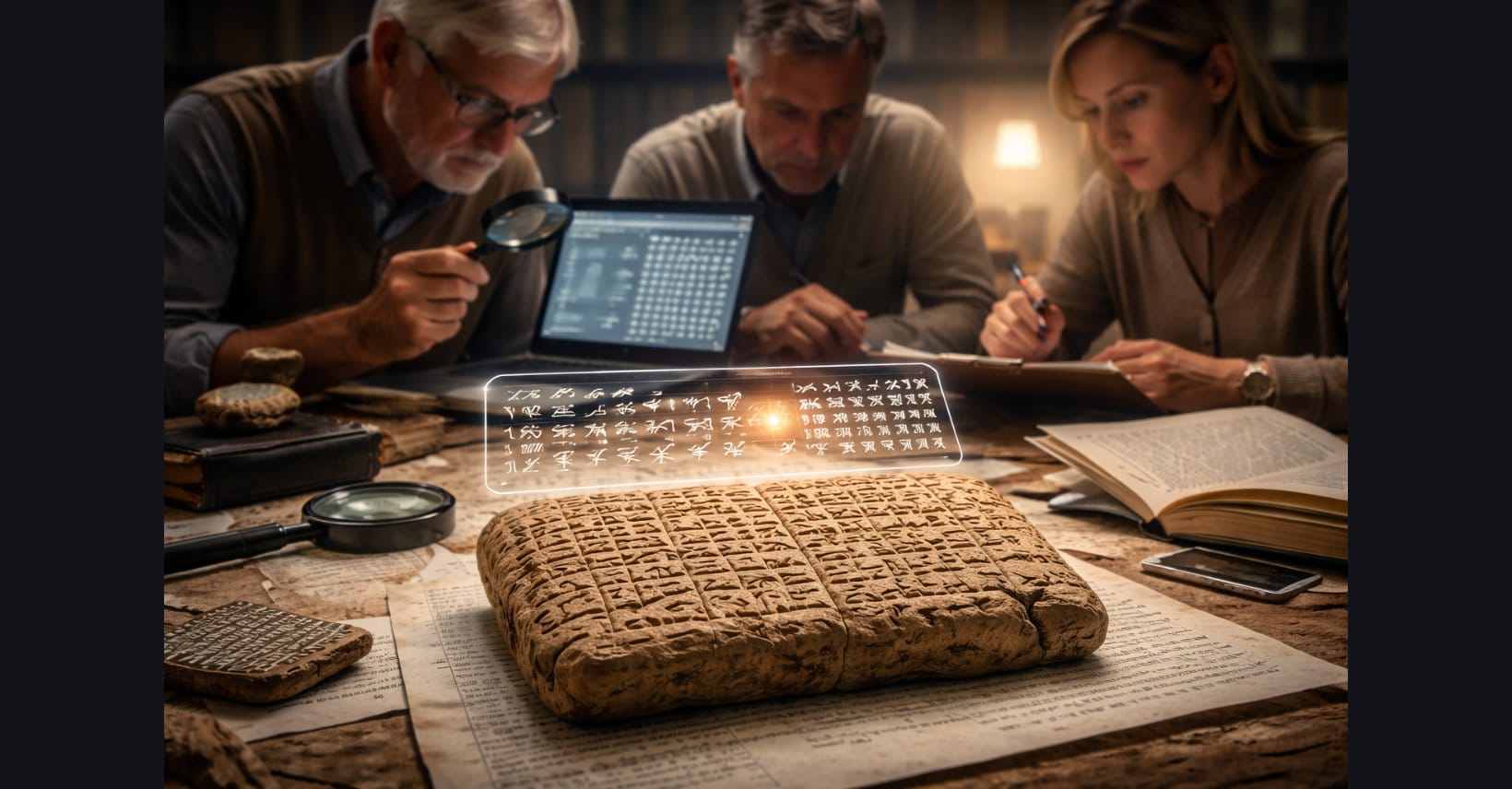
A 4,000-year-old clay tablet in a museum collection has finally been decoded after remaining unread for more than a century. Scholars used comparative linguistics, larger cuneiform databases, and digital analysis to interpret its administrative content, which sheds light on early economic organization and bureaucracy.
The piece argues that artifacts can preserve information long before humans can understand them. It uses the tablet as an example of delayed comprehension in archaeology and history, where meaning emerges only as knowledge, tools, and context accumulate.
For more than a century, a clay tablet inscribed with cuneiform markings sat in a museum collection—cataloged, preserved, and largely unread. Discovered in the early 20th century, it was recognized as ancient but not fully understood. Only now, through advances in comparative linguistics, expanded cuneiform databases, and digital analysis tools, have scholars succeeded in decoding its contents.
The tablet dates back roughly 4,000 years to the early second millennium BCE. What prevented earlier translation was not deterioration, but context. Languages evolve. Dialects shift. Administrative terminology falls out of use. Without parallel texts for comparison, symbols remain opaque. As digital archives grew and machine-assisted pattern recognition matured, researchers were finally able to identify the linguistic framework that unlocked the inscription.
The contents, once deciphered, offered insight into economic organization—trade transactions, allocation records, or administrative accounting tied to a structured governance system. What appears mundane on the surface becomes profound in implication. This was not an isolated artifact. It was a fragment of a functioning information network—evidence of bureaucratic sophistication in a period often characterized in simplified terms.
The most significant detail is not what the tablet says, but what its long silence reveals.
For a century, the artifact existed physically but not intellectually. The information was always present. It simply could not be interpreted. Knowledge, in this case, did not disappear. It waited.
This pattern appears repeatedly in archaeology. Objects are recovered long before their meaning is understood. Scripts remain unread until comparative discoveries provide keys. Technologies are identified before their purpose is grasped. History does not unfold in a straight line of discovery; it unlocks in stages.
Within The Alien Deception Chronicles, this dynamic carries weight. The alien deception framework does not depend on hidden spacecraft or secret archives. It depends on something more subtle: delayed comprehension. Humanity may possess fragments of its own past—texts, structures, artifacts—without yet understanding the full system they belong to.
A decoded tablet does not rewrite civilization overnight. But it does demonstrate that information can outlive the capacity to interpret it. Meaning can be suspended across centuries, preserved in clay while intellectual frameworks rise and fall.
The artifact did not change.
Humanity did.
Each time an unread text becomes legible, the boundary of the known shifts slightly outward. And each shift reminds us that the archive of the past is larger than our current ability to read it.
Understanding, like archaeology itself, is cumulative.
Sometimes the greatest discovery is not what we find—but what we finally comprehend.