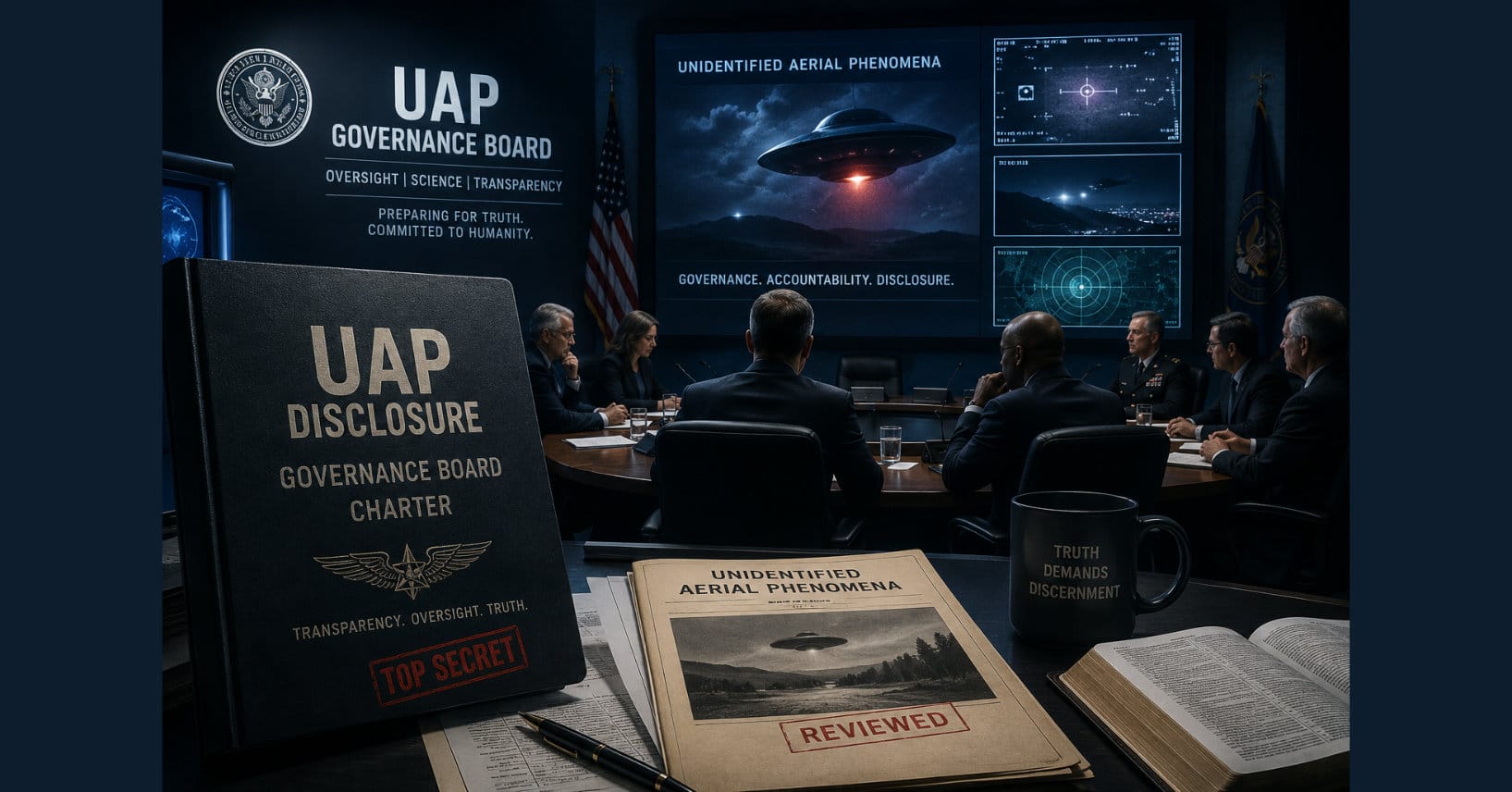
The piece argues that UFO and UAP discussion is shifting from speculation to institutional oversight through government boards, advisors, and formal investigations. It says this development may increase public credibility, but official attention is not proof of extraterrestrial explanation.
It presents a biblical response that urges caution about interpretation, warning that compelling narratives can form around unresolved evidence. The article encourages Christians to follow investigations without assuming disclosure will confirm nonhuman intelligence.
For decades, UFO disclosure was driven largely by eyewitness accounts, independent researchers, and the occasional declassified document. Today, the conversation is changing. Governments are creating formal oversight structures, scientific advisors are being appointed, and unidentified aerial phenomena are increasingly discussed within the language of governance rather than speculation.
That shift is significant.
Recently announced UAP governance initiatives and advisory boards signal that the subject is becoming institutionalized. Whether these organizations ultimately explain sightings as foreign technology, natural phenomena, classified programs, or something else entirely, the public is witnessing an important transition. UFOs are no longer treated simply as curiosities. They are becoming matters of policy, national security, scientific inquiry, and public communication.
For many, that institutional recognition lends credibility to the idea that disclosure is approaching.
From a biblical perspective, however, official attention should never be confused with official confirmation.
Governments investigate many subjects that ultimately prove less extraordinary than initial reports suggest. Responsible oversight does not validate every claim. Rather, it reflects the obligation to investigate reports that may have implications for public safety or national security.
The greater concern lies elsewhere.
As disclosure becomes embedded within respected institutions, many people will naturally assume that extraordinary conclusions are becoming more likely. If government committees exist, surely there must be something extraordinary to disclose.
That assumption deserves careful examination.
Throughout history, institutions have often shaped public expectations as much as public opinion has shaped institutions. Once an idea receives formal attention, it acquires an air of legitimacy regardless of whether definitive evidence has been presented.
This is where The Alien Deception Chronicles raises an important question.
What if the greatest preparation is not the evidence itself, but the framework through which future evidence will be interpreted?
Modern disclosure culture increasingly presents humanity with a familiar narrative. Advanced nonhuman intelligences exist. Governments are slowly revealing the truth. Scientific institutions are preparing the public. A transformational moment is approaching that will redefine humanity’s place in the universe.
It is an extraordinarily compelling story.
It also functions remarkably well as an alternative worldview.
The biblical narrative offers a different foundation. Scripture teaches that humanity’s identity is rooted in creation, not cosmic ancestry. Our greatest need is reconciliation with God, not contact with advanced civilizations. The future is defined not by disclosure from extraterrestrials but by the return of Jesus Christ.
This does not mean Christians should ignore legitimate investigations into unidentified aerial phenomena. Serious questions deserve serious investigation. Governments should examine reports. Scientists should analyze evidence. Skepticism and curiosity are both appropriate responses.
But believers should also remember that every investigation eventually produces interpretations.
Evidence and interpretation are not the same thing.
An unexplained object may remain unexplained for years. The temptation is to allow speculation to fill the gap before evidence does.
Scripture repeatedly warns that deception flourishes when compelling explanations replace careful discernment. The most persuasive narratives are rarely built upon obvious falsehoods. They are constructed by combining genuine mysteries with conclusions people are already prepared to accept.
As governance structures surrounding UAPs continue to expand, Christians should watch with interest—but not with unquestioning confidence.
The existence of a governance board does not prove extraterrestrial intelligence.
It does demonstrate that society is increasingly preparing for the possibility.
The question every believer should ask is not, “What are they investigating?”
The more important question is, “How will the world interpret whatever they eventually announce?”