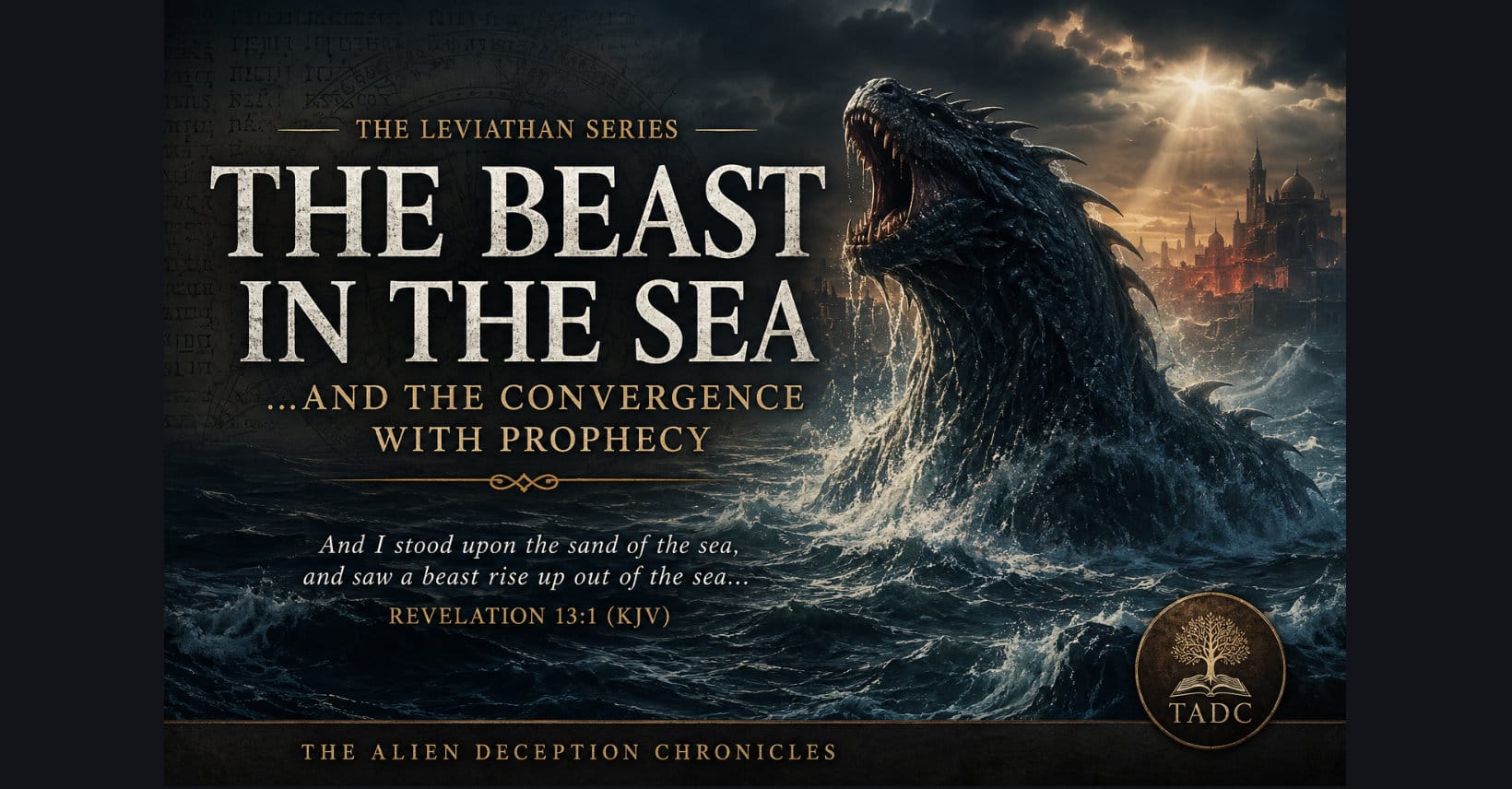
The post traces recurring sea, serpent, and beast imagery across Scripture and ancient traditions, arguing that these symbols consistently evoke inaccessible realms, chaos, and opposition to human authority. It emphasizes caution, noting that the parallels suggest continuity of pattern rather than a direct identification of Leviathan with any single figure.
It then links these motifs to Revelation, where a beast rises from the sea and a dragon is identified with Satan. The conclusion is that ancient descriptions, biblical symbolism, and prophetic imagery converge around themes of deception, rebellion, and the limits of human understanding.
Throughout this series, one pattern has remained remarkably consistent.
Across Scripture and ancient civilizations, we encountered:
- Serpent-like entities
- Association with the deep or unseen
- Resistance to human authority
- Conflict tied to order and chaos
- Repeated placement within inaccessible domains
At each step, the goal has been restraint.
Not to force conclusions.
Not to sensationalize ancient texts.
But to examine recurring patterns carefully and honestly.
Now, as the inquiry concludes, another passage emerges—one that has remained quietly connected to the entire discussion from the beginning.
A passage from the Book of Revelation.
And once again…
The sea appears.
The Beast Rises
Revelation 13:1 (KJV) opens with a striking image:
“And I stood upon the sand of the sea, and saw a beast rise up out of the sea…”
The language immediately feels familiar.
Not because Revelation repeats Leviathan directly—but because it returns to the same symbolic framework:
- The sea
- The beast
- The emergence of power from an inaccessible domain
This does not mean the beast of Revelation is Leviathan.
The text does not say that.
But the convergence of imagery deserves careful attention.
The Sea as More Than Geography
By now, the sea has appeared repeatedly throughout this series.
In:
- The Book of Isaiah
- Ugaritic tradition
- Mesopotamian cosmology
- Egyptian mythology
the deep consistently functions as:
- A domain beyond human governance
- A setting tied to mystery and danger
- A place from which opposition emerges
Revelation preserves that same structure.
The beast does not descend from the mountains.
It does not emerge from the desert.
It rises from the sea.
Symbolism—and Something More
Revelation is deeply symbolic.
That must be stated clearly.
The imagery operates at theological, prophetic, and spiritual levels simultaneously.
But symbolism in Scripture is rarely random.
The symbols are chosen deliberately.
Which raises an important question:
Why does prophetic imagery continue to draw from the same framework established in earlier texts?
Why the sea?
Why the beast?
Why emergence from the deep?
The continuity is difficult to ignore.
The Return of Ancient Patterns
One of the most striking aspects of Revelation is how often it revisits older biblical themes.
The beast imagery recalls:
- Daniel’s visions
- Chaos motifs from the Old Testament
- Serpent and dragon symbolism already established in Scripture
This creates a convergence point:
Ancient patterns reappear within future-oriented prophecy.
Not as disconnected myths.
But as recurring imagery tied to rebellion, deception, and power.
The Dragon Behind the Beast
Later in Revelation, another familiar image appears:
“And the great dragon was cast out, that old serpent, called the Devil, and Satan…” (Revelation 12:9, KJV)
Here, the symbolism becomes explicit.
The dragon-serpent imagery that echoes through ancient texts is directly connected to spiritual deception and opposition to God.
Again, restraint matters.
This does not mean every ancient serpent tradition refers to Satan directly.
But it does establish something important:
Scripture itself preserves the serpent-dragon framework as spiritually significant.
A Framework of Deception
Within the broader themes of The Alien Deception Chronicles, this becomes particularly relevant.
Modern culture often treats ancient accounts as:
- Primitive mythology
- Symbolic fiction
- Misunderstood superstition
But Revelation suggests something more complex.
It presents a future in which:
- Deception intensifies
- Symbols become manifestations
- Humanity misinterprets what it sees
That possibility reframes the earlier discussion.
Perhaps ancient people were not simply inventing myths.
Perhaps they were describing encounters through limited language and symbolic structure.
The Danger of Overreach
This is where caution becomes essential.
It would be easy to:
- Equate every ancient serpent with Revelation’s dragon
- Force modern phenomena into prophetic frameworks
- Treat symbolic language as technical prediction
That approach weakens credibility.
Instead, the stronger observation is this:
The same imagery persists across:
- Ancient civilizations
- Biblical texts
- Prophetic literature
And the continuity is intentional enough to deserve examination.
A Convergence, Not a Conclusion
The purpose of this series has never been to prove the identity of Leviathan.
It has been to follow the pattern honestly wherever it leads.
And where it leads, ultimately, is convergence.
A convergence of:
- Ancient description
- Mythological repetition
- Biblical symbolism
- Prophetic imagery
All connected through recurring themes:
- The sea
- The serpent
- The beast
- The adversary
- The unseen
What Remains Unanswered
Many questions remain unresolved.
Was Leviathan:
- Literal?
- Symbolic?
- Both?
Were ancient civilizations:
- Borrowing stories?
- Sharing memories?
- Compressing observations into mythological language?
The series has intentionally left those questions open.
Because forcing certainty where Scripture allows tension often produces distortion.
A Final Reflection
Perhaps the most important realization is not what Leviathan was.
But what the pattern reveals about humanity itself.
Across civilizations and centuries, people repeatedly described:
- Something powerful
- Something beyond control
- Something emerging from domains they could not fully understand
And in Scripture, those patterns ultimately converge into a warning:
That deception does not always appear monstrous.
Sometimes it rises from the deep slowly…
wrapped in symbols humanity no longer recognizes.
That possibility does not demand fear.
But it does invite vigilance.
And perhaps that is why these ancient images still endure.
Not merely to fascinate us…
…but to remind us that humanity has always struggled to distinguish between:
- the unknown,
- the symbolic,
- and the spiritually real.