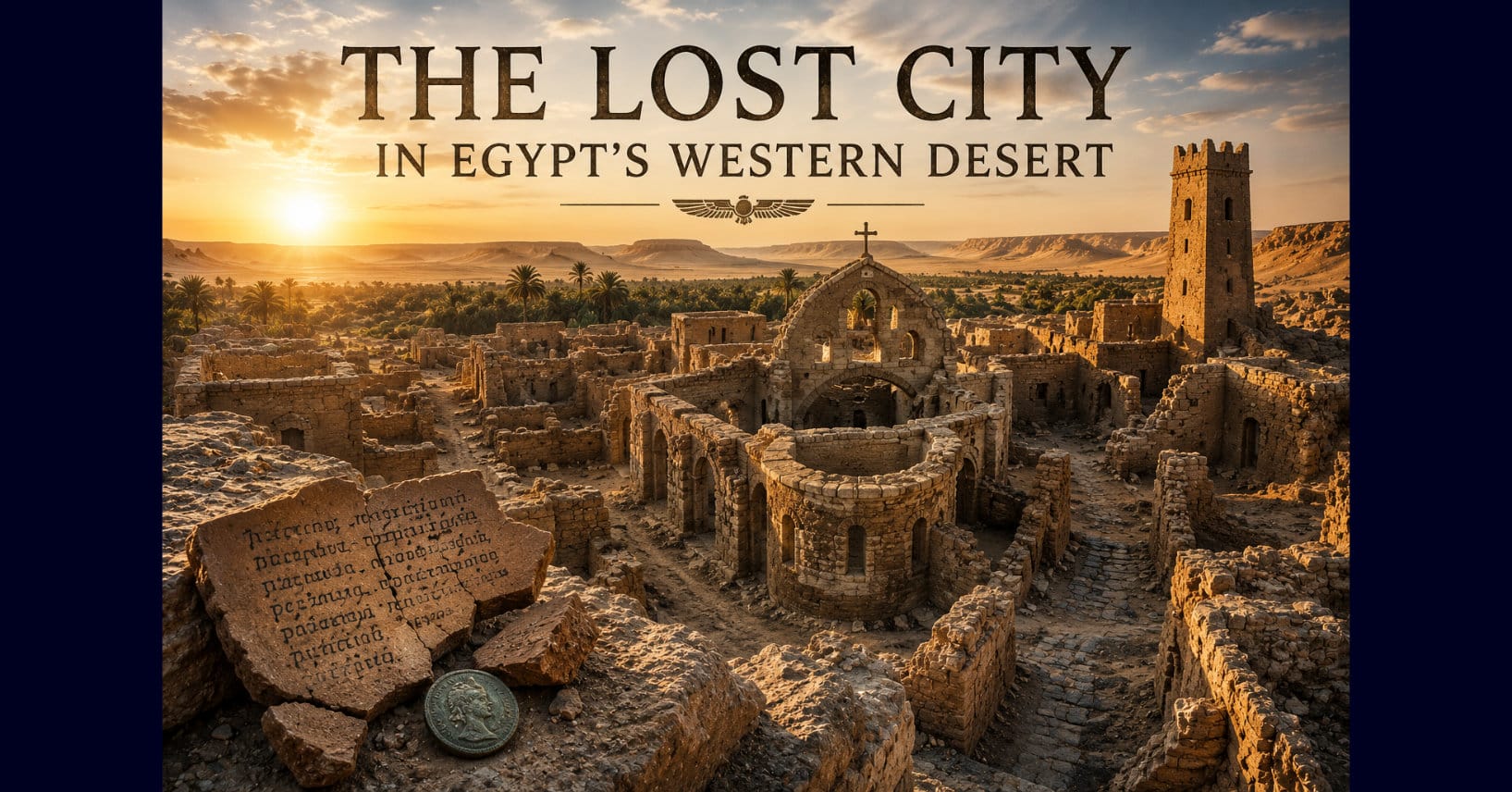
A newly uncovered settlement at Egypt’s Dakhla Oasis is revealing the remains of an organized Byzantine-era community complete with residential buildings, streets, defensive structures, ovens, inscribed pottery, coins, and a Christian basilica. The Lost City in Egypt’s Western Desert examines what the discovery tells us about ancient human ingenuity, why “lost cities” so easily attract speculation about forgotten civilizations and extraterrestrial teachers, and how a biblical worldview gives humanity ample reason to possess remarkable creative and technological abilities without intervention from the stars.
For centuries, Egypt’s deserts have preserved what history forgot.
Beneath layers of sand lie abandoned settlements, temples, cemeteries, roads, fortifications, and fragments of ordinary life from civilizations that once appeared permanent. Archaeologists continue to recover these places, sometimes revealing communities whose existence had largely disappeared from public memory.
A newly uncovered settlement in Egypt’s Western Desert offers another remarkable example.
Archaeologists working at the Dakhla Oasis have uncovered the remains of a well-preserved settlement dating to the Byzantine period, beginning around the fourth century AD. The site contains residential buildings, streets, public spaces, defensive structures, watchtowers, bread ovens, grinding installations, pottery, coins, and other evidence of organized community life.
Among the most significant discoveries is a basilica-style church, demonstrating the Christian presence within the oasis community.
Researchers have also recovered more than 200 inscribed pottery fragments—ostraca—that preserve pieces of everyday communication, administration, and commerce.
The discovery provides something archaeology does particularly well.
It allows people who disappeared from written history to speak again.
Civilization Where We Do Not Expect It
To modern eyes, Egypt’s Western Desert can appear hostile to permanent settlement.
That perception makes discoveries at desert oases particularly fascinating.
How did substantial communities survive there?
How did they organize trade?
Where did they obtain water?
How were food, security, worship, and government maintained?
These are legitimate archaeological questions.
But they also illustrate how quickly modern assumptions about ancient people can distort our interpretation of the past.
When archaeologists uncover unexpectedly sophisticated settlements in difficult environments, popular speculation often begins with disbelief.
How could people have lived there?
How could they have built this?
How could they have known how to organize such a community?
Those questions can be useful.
The problem begins when they become:
They could not have done this without help.
That assumption has fueled generations of claims about lost civilizations, forgotten advanced technologies, and extraterrestrial teachers.
Yet the Dakhla Oasis settlement tells a much more human story.
People adapted.
They engineered solutions.
They organized communities.
They traded.
They worshipped.
They raised families.
They built institutions.
And eventually their city disappeared from common memory.
No extraterrestrial intervention is required.
When “Lost” Becomes “Advanced”
The phrase lost city carries enormous imaginative power.
It suggests secrets.
Hidden knowledge.
Forgotten civilizations.
Perhaps even technologies that vanished with the people who possessed them.
That fascination is understandable.
Entire cities really can disappear.
Civilizations really can collapse.
Knowledge really can be lost.
But none of those facts establishes the existence of a technologically superior civilization erased from conventional history.
A city can be lost simply because people leave.
Trade routes change.
Water supplies fail.
Political authority collapses.
War disrupts settlement.
Disease alters populations.
Economic centers move elsewhere.
Sand covers what remains.
Generations pass.
Eventually, the location survives only in fragments—or disappears from memory altogether.
Rediscovery can feel revolutionary without requiring history to be rewritten.
The Ancient-Alien Shortcut
Ancient-alien narratives frequently exploit the distance between what archaeologists know and what remains uncertain.
If an ancient society demonstrates sophisticated engineering, astronomy, medicine, mathematics, architecture, or urban planning, the accomplishment is treated as evidence that someone else must have supplied the knowledge.
The irony is difficult to miss.
A theory supposedly intended to honor ancient civilizations often begins by denying those civilizations credit for their achievements.
The biblical worldview has no need for that assumption.
Scripture presents human beings as intelligent, creative, technological, social, and spiritually aware from very early in human history.
Genesis describes people building cities, raising livestock, making musical instruments, and working metals.
Human creativity is not an evolutionary surprise that suddenly appeared in the modern age.
It reflects something deeper.
“So God created man in his own image, in the image of God created he him;”
—Genesis 1:27, KJV
Humanity possesses extraordinary creative capacity because humanity was created by an extraordinary Creator.
That does not mean every ancient civilization worshipped God faithfully.
Quite the opposite.
Human ingenuity can produce temples as easily as churches, idols as easily as tools, and systems of oppression as easily as systems of commerce.
Intelligence does not guarantee truth.
A Christian City Beneath the Sand
The basilica at the Dakhla settlement adds another dimension to the discovery.
Christian communities existed across Egypt for centuries, including in places far removed from the great urban centers along the Nile.
The church therefore reminds us that Christianity was not confined to Rome, Jerusalem, or Constantinople.
Believers lived in remote communities.
They worshipped.
They worked.
They raised children.
They buried their dead.
They participated in the ordinary rhythms of civilization.
Eventually, their buildings fell silent.
The sand covered them.
Yet archaeological evidence remained.
There is something humbling about that.
Every civilization believes its institutions are permanent while living inside them.
They are not.
Cities disappear.
Governments collapse.
Languages change.
Trade routes vanish.
Buildings become ruins.
And people who once considered themselves part of the present become archaeology.
The Real Lesson of a Lost City
The Dakhla Oasis discovery deserves attention precisely because it does not require sensationalism.
A sophisticated community existed in Egypt’s Western Desert.
Its people adapted to a difficult environment.
They developed an organized settlement with homes, streets, defensive structures, economic activity, written communication, and Christian worship.
Then history moved on.
The city was lost.
Now it is being recovered.
For The Alien Deception Chronicles, discoveries like this provide an important lesson.
Mystery should inspire investigation.
It should not become permission to invent an explanation.
When ancient people accomplish something remarkable, the first response should not be to search the heavens for someone else to credit.
Sometimes the civilization we thought impossible was simply human.
Sometimes the technology we thought mysterious was ingenuity.
Sometimes the knowledge we thought lost was never extraterrestrial.
And sometimes a lost city beneath the desert tells us something far more profound than any ancient-alien theory ever could:
Human civilizations rise.
Human civilizations disappear.
But the Creator before whom they rise and fall remains.