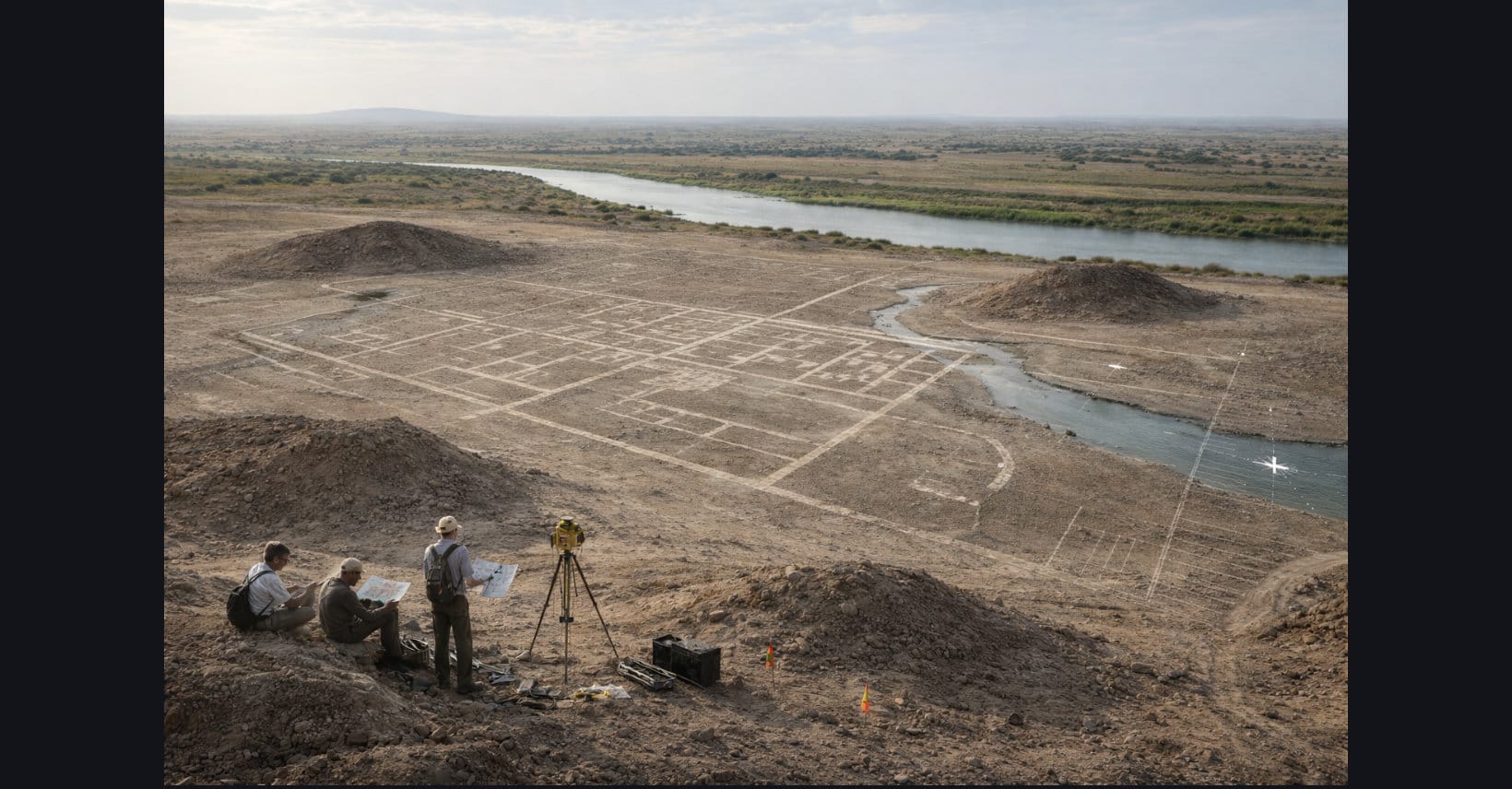
Archaeologists in southern Iraq are confirming the rediscovery of a long-suspected Hellenistic city believed to be Alexandria on the Tigris. Drone surveys, magnetometry, radar, and artifacts indicate a planned urban center with streets, canals, fortifications, and civic structures from the Seleucid period.
The finding suggests a major port and trade hub once linked Mediterranean power to eastern networks. Its burial under silt and shifting river channels shows how environmental change can erase major settlements while leaving their historical importance intact.
In the flat, wind-swept plains of southern Iraq, near the shifting channels of the Tigris River, archaeologists are confirming the rediscovery of what is widely believed to be Alexandria on the Tigris—a major Hellenistic port city founded in the wake of Alexander the Great’s eastern campaigns. Long suspected but never definitively mapped, the site is now emerging through drone surveys, magnetometry, and ground-penetrating radar that reveal a structured urban grid beneath layers of silt and desert sediment.
The outlines are unmistakable: orthogonal street patterns, canal systems branching toward ancient river courses, fortified boundaries, and large civic complexes consistent with a planned Hellenistic metropolis. Ceramic assemblages and coinage tie the settlement to the Seleucid period, when Greek administrative systems fused with older Mesopotamian knowledge traditions. This was not a frontier outpost. It was a strategic node linking Mediterranean political power to eastern trade networks extending toward the Persian Gulf.
What makes this rediscovery particularly relevant is not only the city itself, but the timeline of its recognition. Satellite imagery and surface anomalies had long suggested irregular subsurface formations in the region, yet formal academic consolidation and broad acknowledgment came only after coordinated surveys validated what remote sensing hinted at. This pattern—evidence existing in fragments before institutional confirmation—mirrors the broader dynamics of disclosure seen in archaeology and anomaly research alike. Data accumulates quietly. Consensus resists premature conclusions. Confirmation arrives gradually. Public understanding adjusts only once the shift becomes unavoidable.
The significance lies not merely in scale, but in implication. Southern Iraq—ancient Mesopotamia—is often described as the cradle of civilization, a region so deeply studied that little of consequence could remain hidden. Yet here, beneath farmland and dust, lay the footprint of a city large enough to recalibrate regional economic history. Its disappearance was likely environmental: river migration, sediment deposition, and the rerouting of trade corridors. But environmental erasure does not negate historical impact.
For readers of The Alien Deception Chronicles, this rediscovery reinforces a recurring pattern: sophisticated centers of knowledge can vanish from the visible record while their influence lingers beneath the surface. Each time such a site resurfaces, prevailing historical models must expand. What was once considered peripheral becomes infrastructural. What was assumed lost proves merely buried.
Hellenistic cities were not only administrative capitals. They were convergence points—where astronomy, engineering, commerce, and religious systems intersected. When one disappears for centuries, we are reminded that the human record is incomplete, layered, and vulnerable to natural forces.
The desert of southern Iraq is not empty. It is archival. Modern imaging now functions like an X-ray across time, revealing that beneath apparently barren terrain lie organized systems more interconnected than surviving texts alone suggest.
History is not static. It is sedimentary. And occasionally, the ground yields back what it once concealed.