Summary
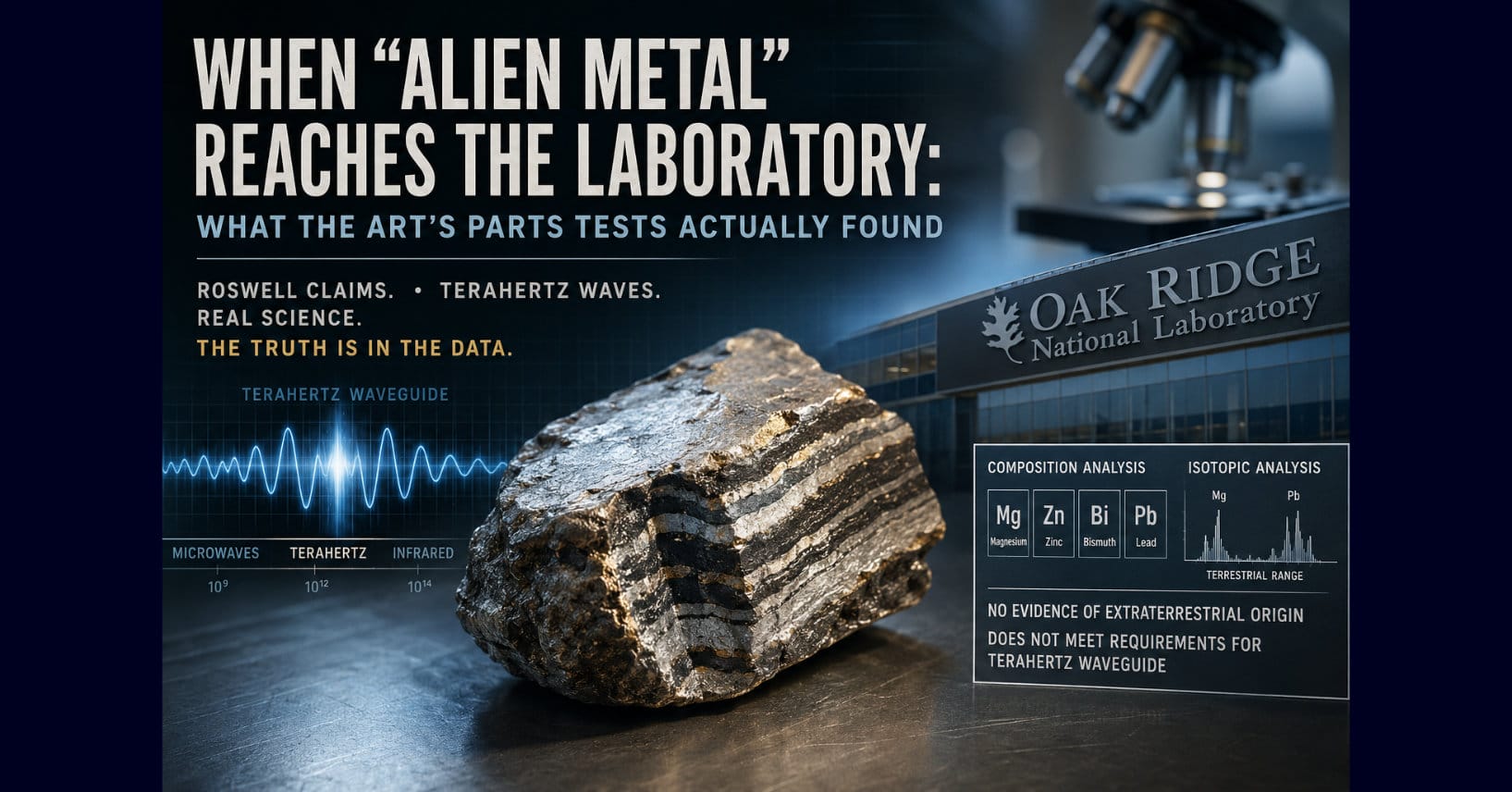
For decades, a layered metallic specimen known as “Art’s Parts” has been associated with claims of recovered UFO debris and advanced propulsion technology. Oak Ridge National Laboratory eventually analyzed the material, examining its composition, isotope ratios, and the claim that its microscopic layers could function as a terahertz waveguide.
The laboratory found an unusual material—but not extraterrestrial technology. This article examines the physics behind the claim, what scientists actually discovered, and why the distinction between evidence and interpretation matters. For Christians, the case also raises a larger question explored throughout The Alien Deception Chronicles: What happens when genuine phenomena are accompanied by a persuasive but potentially false explanation?
For decades, one of the most persistent questions surrounding the UFO phenomenon has been remarkably simple:
Where is the physical evidence?
Photographs can be disputed. Eyewitness testimony can be challenged. Radar returns can be interpreted in different ways. Even extraordinary military encounters can leave investigators debating what was actually observed.
But a piece of metal is different.
Metal can be weighed.
It can be placed beneath a microscope.
Its chemical composition can be measured. Its isotopes can be analyzed. Its internal structure can be examined.
And if someone claims that a piece of metal came from a spacecraft manufactured somewhere other than Earth, the laboratory becomes a very important place.
That is essentially what happened with a small metallic specimen sometimes associated with the legendary Roswell story.
The object was real.
The claims surrounding it were extraordinary.
And eventually, scientists were given an opportunity to test them.
What they found provides an unusually useful case study—not merely for understanding UFO claims, but for understanding how extraordinary narratives develop around genuinely unusual evidence.
A Fragment With an Extraordinary Story
The material is often associated with what UFO researchers have called “Art’s Parts.”
The name traces back to radio host Art Bell, who reportedly received metallic samples during the 1990s accompanied by claims that they had originated from debris recovered from a crashed unidentified craft in New Mexico in 1947.
That date immediately carries enormous cultural significance.
1947 was the year of the Roswell incident.
Over the decades, the story surrounding Roswell evolved from reports of recovered debris into allegations involving extraterrestrial spacecraft, recovered bodies, secret government programs, and eventually reverse-engineering efforts.
The metallic specimen became connected with that larger mythology.
But there was an immediate problem.
Its chain of custody could not be independently verified.
There was no documented evidentiary trail beginning at a crash site in 1947 and continuing uninterrupted to the laboratory decades later.
That distinction matters.
Scientists could test the material.
They could not scientifically reconstruct its entire history merely by examining it.
Nevertheless, the specimen itself contained characteristics unusual enough to generate considerable interest.
And the claims surrounding it eventually became much more sophisticated than simply saying, “This came from a UFO.”
From Strange Metal to Advanced Technology
The specimen consisted primarily of magnesium, along with zinc and extremely thin layers containing bismuth and lead.
That layered structure became important.
Some researchers proposed that the arrangement might represent an engineered metamaterial—something whose unusual physical structure could produce properties not normally associated with its individual components.
The speculation became even more intriguing when researchers suggested that the material might interact with electromagnetic radiation in the terahertz frequency range.
That requires some explanation.
A terahertz waveguide sounds like something invented for a science-fiction novel. The underlying physics, however, is quite real.
A waveguide is simply a structure designed to direct electromagnetic energy along a particular path.
Electromagnetic waves naturally tend to spread as they travel. A waveguide constrains that energy so that it travels through or along a particular structure instead.
The principle is already used extensively in modern technology.
Metallic waveguides can carry microwave signals. Optical fibers perform a conceptually similar function with light, keeping light confined as it travels through the fiber. Antennas, radar systems, telecommunications equipment, and scientific instruments all employ methods for controlling electromagnetic waves.
The unusual part of this particular claim involved the frequency.
What Does “Terahertz” Mean?
The electromagnetic spectrum includes everything from extremely low-frequency radio waves to microwaves, infrared radiation, visible light, ultraviolet radiation, X-rays, and gamma rays.
Terahertz radiation occupies a region between microwaves and infrared light.
The word itself describes frequency.
One hertz means one cycle per second.
One kilohertz means one thousand cycles per second.
One megahertz means one million.
One gigahertz means one billion.
And one terahertz means one trillion cycles per second.
Terahertz radiation therefore represents electromagnetic waves oscillating extraordinarily rapidly.
Scientists are interested in this region of the spectrum because terahertz waves have potential applications in imaging, spectroscopy, communications, materials analysis, security scanning, and other advanced technologies.
So when researchers proposed that the alleged UFO fragment might function as a terahertz waveguide, they were making a specific physical claim.
They were suggesting that its microscopic layered structure might have been deliberately engineered to control or channel electromagnetic radiation at terahertz frequencies.
That possibility could be investigated scientifically.
But the story did not stop there.
From Waveguides to Antigravity
A terahertz waveguide by itself is not an antigravity device.
That distinction is important.
Waveguides are legitimate components of electromagnetic engineering. There is nothing extraterrestrial or inherently exotic about directing electromagnetic radiation through a specially designed structure.
The extraordinary claim surrounding Art’s Parts was that its particular arrangement of magnesium, bismuth, lead, and other elements might do considerably more.
Some speculation connected the structure to exotic propulsion concepts involving gravity or inertia.
The suggestion was that electromagnetic interactions occurring within the microscopic layers might somehow contribute to a reduction of inertial mass.
Inertia is the tendency of an object to resist changes in its motion.
Push a lightweight object and it accelerates easily.
Push something enormously massive with the same force and its acceleration is much smaller.
If a technology could somehow alter an object’s inertial properties, the implications for propulsion would be profound. A vehicle capable of manipulating inertia might theoretically perform accelerations or maneuvers impossible for conventional aircraft.
That is one reason such ideas became attractive within UFO research.
Reports of unidentified craft frequently describe extreme acceleration, abrupt changes in direction, hovering without visible means of propulsion, or movements apparently inconsistent with conventional aerodynamics.
If those observations were accurate, some mechanism would be required to explain them.
An exotic material capable of interacting with electromagnetic fields in an unusual way therefore offered an intriguing possibility.
Perhaps, some speculated, this strange fragment was not merely structural material.
Perhaps it was part of the propulsion system.
That transformed the significance of the specimen.
If the hypothesis were correct, the small fragment could potentially represent evidence of an advanced technology far beyond what was publicly known in 1947.
But there was a problem.
The proposed mechanism depended upon the material actually possessing the physical characteristics necessary to perform that function.
That was something scientists could test.
Oak Ridge Gets the Sample
In 2022, the Department of Defense’s All-domain Anomaly Resolution Office, better known as AARO, contracted Oak Ridge National Laboratory to examine the specimen.
Oak Ridge was an appropriate place for the investigation.
The laboratory possesses sophisticated capabilities for materials characterization, including microscopy, spectroscopy, and mass spectrometry.
The researchers were essentially asked to investigate two major questions.
First, was there evidence suggesting the material was extraterrestrial in origin?
Second, did its physical structure support claims that it could function as the proposed terahertz waveguide associated with exotic propulsion concepts?
These were no longer simply questions of UFO folklore.
They were testable questions involving chemistry, materials science, and physics.
And that is where the story becomes particularly interesting.
Because once the specimen entered the laboratory, the mythology surrounding it became secondary.
The atoms had to speak for themselves.
What the Scientists Found
The analysis identified magnesium as the primary material, with zinc present at several percent and thin repeating regions containing bismuth and lead.
The layered construction was certainly interesting.
But unusual does not automatically mean extraterrestrial.
One of the most useful tools for investigating the origin of a material is isotopic analysis.
Elements can exist in several forms called isotopes. They contain the same number of protons—which makes them the same element—but different numbers of neutrons.
The relative abundance of those isotopes can sometimes provide clues about where material originated or how it was produced.
Materials formed in different environments can possess distinctive isotopic ratios. Scientists use such measurements when studying meteorites, planetary material, geology, nuclear processes, and many other subjects.
If this specimen had contained isotope ratios dramatically inconsistent with terrestrial materials, that would have been significant.
It did not.
The magnesium and lead isotope ratios examined by Oak Ridge fell within terrestrial ranges.
Nothing about those measurements required an extraterrestrial explanation.
Researchers then examined the proposed terahertz-waveguide hypothesis.
Here again, the physical evidence failed to support the more extraordinary interpretation.
For the proposed waveguide mechanism to work as described, the microscopic layers—particularly the bismuth—would need particular structural and material characteristics.
The specimen did not possess them.
The bismuth-containing layers were not configured with the purity and structure required for the specimen to channel terahertz radiation in the manner that had been proposed.
In other words, the laboratory found an unusual layered metal.
It did not find evidence that those layers constituted the exotic electromagnetic device described by the hypothesis.
AARO ultimately summarized the Oak Ridge findings by concluding that the specimen was terrestrial in origin and did not possess the characteristics necessary to function as the claimed terahertz waveguide.
There was another intriguing possibility.
The unusual construction may have originated from experimental materials research conducted during the twentieth century.
In other words, the specimen may indeed represent unusual engineering.
Just not alien engineering.
That Does Not Make the Story Meaningless
There is a temptation when discussing subjects like this to divide everything into two camps.
Either the object is extraterrestrial technology, or the entire story is nonsense.
That is a false choice.
The specimen exists.
Its unusual layered construction exists.
The history surrounding it exists.
The claims made about it exist.
What the laboratory analysis challenged was the interpretation placed upon those facts.
That distinction is essential.
An anomaly is not an explanation.
Something can be unusual without being extraterrestrial.
Something can be unexplained without being supernatural.
And something can have an uncertain history without every proposed history being equally probable.
This particular specimen demonstrates the importance of separating three questions:
What did we observe?
What can we demonstrate?
What are we inferring from what we observed?
Those questions become increasingly important as public discussion of unidentified anomalous phenomena moves deeper into scientific and technological language.
The Power of Scientific Vocabulary
Consider the terminology surrounding this single fragment of metal:
Metamaterial.
Terahertz waveguide.
Isotopic analysis.
Technosignature.
Inertial mass reduction.
Advanced propulsion.
These are impressive terms.
More importantly, most of them describe legitimate scientific concepts.
That is precisely why they can be persuasive.
Scientific terminology can create an impression of scientific certainty even when the underlying proposition remains speculative.
A claim does not become stronger simply because its vocabulary becomes more sophisticated.
“Metal from a flying saucer” sounds like folklore.
“An engineered metamaterial exhibiting terahertz properties consistent with an extraterrestrial technosignature” sounds considerably more authoritative.
Yet both statements could ultimately be making the same unsupported inference.
Changing the vocabulary does not change the evidence.
This distinction will become increasingly important as UAP discussions intersect with physics, artificial intelligence, quantum mechanics, consciousness research, and speculative theories about other dimensions.
Technical vocabulary can explain evidence.
It can also conceal the distance between evidence and interpretation.
Discernment requires knowing the difference.
The Laboratory Is Not the Enemy of Faith
Christians sometimes approach stories like this from opposite extremes.
One response is immediate dismissal.
UFOs are nonsense. Ignore everything associated with them.
The other response is immediate acceptance.
Something unusual has been discovered; therefore, conventional explanations must be wrong.
Neither approach represents particularly careful discernment.
Scripture provides a better principle:
“Prove all things; hold fast that which is good.”
—1 Thessalonians 5:21, KJV
The word “prove” here carries the sense of testing or examining.
That principle is remarkably appropriate for this discussion.
Oak Ridge tested the material.
The testing did not support the extraordinary claims.
That should matter.
Christian discernment should never require us to fear legitimate investigation. If something is true, examining the evidence should not threaten it.
At the same time, scientific analysis has boundaries.
Oak Ridge could determine the specimen’s composition.
It could examine its isotopic ratios.
It could study its microscopic layers.
It could evaluate whether its structure supported the proposed terahertz application.
It could not place the fragment in New Mexico in 1947.
That would require historical evidence and a reliable chain of custody that the specimen does not possess.
Knowing what science can establish is just as important as respecting what science discovers.
Why This Matters to The Alien Deception Chronicles
The central premise explored throughout The Alien Deception Chronicles is not that every UFO report represents demonic activity.
Nor is it that every unexplained phenomenon must have a spiritual explanation.
That would merely replace one premature conclusion with another.
The deeper question is how humanity might interpret extraordinary phenomena if confronted with something it cannot easily explain.
That is where this small piece of metal becomes surprisingly relevant.
Imagine that tomorrow an object appeared with properties scientists genuinely could not explain.
Imagine respected laboratories confirmed that its composition or behavior appeared unprecedented.
Perhaps it manipulated electromagnetic energy in ways previously considered impossible.
Perhaps its isotopic composition could not easily be reconciled with known terrestrial sources.
Perhaps it appeared capable of affecting inertia or gravity.
Those findings would deserve serious scientific attention.
But then something else would happen.
Governments, scientists, intelligence agencies, journalists, technology companies, religious figures, social-media personalities, and self-proclaimed contactees would begin telling us what the discovery meant.
The scientific observations would be one thing.
The interpretation placed upon them would be something else entirely.
And those two things could quickly become almost indistinguishable in the public mind.
That is where discernment would become critical.
The danger would not necessarily be fabricated evidence.
The evidence might be perfectly real.
The danger could reside in the explanation attached to it.
When Evidence Becomes Narrative
Modern society has enormous confidence in technological explanations.
That confidence is often justified. Technology has transformed nearly every dimension of human life.
But technological language can also become a framework through which humanity interprets things that previous generations might have understood very differently.
Angels become extraterrestrials.
Spiritual beings become interdimensional intelligences.
Miracles become advanced physics.
Prophecy becomes contact.
Supernatural manifestations become technology.
None of those reinterpretations becomes true merely because the vocabulary sounds modern.
This is one of the speculative theological questions underlying The Alien Deception Chronicles:
What if humanity encountered genuine phenomena but accepted the wrong explanation for them?
Scripture repeatedly warns about deception, including deception accompanied by impressive manifestations.
That does not prove that contemporary UAP phenomena are fulfillment of those warnings.
It does, however, give Christians reason to evaluate extraordinary claims carefully rather than allowing cultural excitement—or scientific-sounding terminology—to determine their interpretation.
The Most Important Finding May Not Be About the Metal
The Oak Ridge analysis did something valuable.
It moved the conversation from speculation toward measurement.
The alleged UFO fragment could finally be examined with sophisticated scientific instruments.
And the extraordinary claims did not survive that examination.
The material appears terrestrial.
Its isotope ratios were terrestrial.
Its structure did not support the proposed terahertz-waveguide function.
That does not solve every mystery surrounding UAPs.
It does not prove that every unusual object has a conventional explanation.
And it certainly does not settle the broader cultural debate surrounding UFOs.
But it demonstrates exactly how extraordinary claims should be approached.
Test what can be tested.
Separate observation from interpretation.
Recognize the limits of the evidence.
Remain willing to change conclusions when the evidence changes.
And never allow impressive terminology to substitute for proof.
Because one day the artifact placed on the laboratory table may be far more difficult to explain.
If that day comes, the most important question may not simply be:
What is it?
The more consequential question may be:
Who is telling us what it means?