Summary
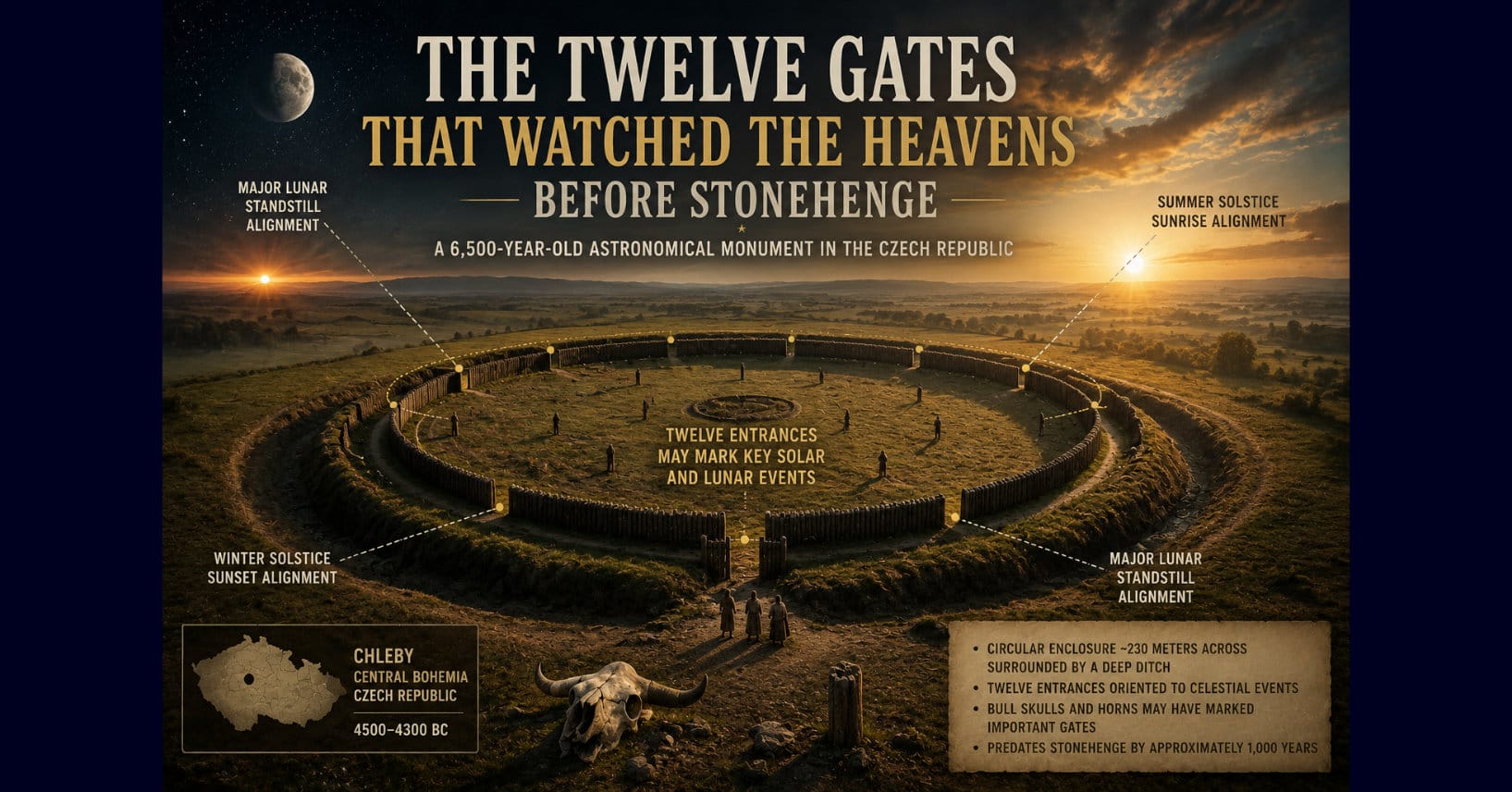
Archaeologists studying a massive Neolithic enclosure at Chleby in the Czech Republic have identified twelve entrances that may correspond with significant solar and lunar events. Dating to approximately 4500–4300 BC, the roughly 230-meter-wide monument predates Stonehenge by about a millennium and may have combined astronomical observation with ceremonial activity.
The Twelve Gates That Watched the Heavens Before Stonehenge examines what the discovery reveals about the sophistication of prehistoric communities—and why remarkable ancient knowledge does not require extraterrestrial teachers. Rather than diminishing ancient humanity by attributing its achievements to lost supercivilizations or alien intervention, the evidence invites us to reconsider how much early people could accomplish through observation, memory, cooperation, and generations of accumulated knowledge.
More than 6,500 years ago, people living in what is now the Czech Republic undertook an extraordinary project.
They dug a circular enclosure approximately 230 meters—more than 750 feet—across. They surrounded it with a ditch more than 2.5 meters deep. They apparently erected wooden barriers within the complex.
And around its perimeter, they created twelve entrances.
At first, the entrances seemed irregular.
Then archaeologists began examining where they pointed.
The geometry may have been anything but random.
Researchers led by Petr Krištuf of the University of West Bohemia now report that the entrances appear to form a system associated with important positions of the Sun and Moon. The monument may have allowed people standing at particular locations to observe the summer-solstice sunrise, winter-solstice sunset, and significant points in the lunar cycle.
The structure at Chleby predates Stonehenge by roughly a thousand years.
Once again, archaeology is forcing us to reconsider what supposedly “primitive” people were capable of doing.
Twelve Openings in an Ancient Circle
The monument lies near the village of Chleby in Central Bohemia.
Circular Neolithic enclosures are known elsewhere in Europe, but according to the University of West Bohemia researchers, a structure of this kind is unknown in this region for the period in which Chleby was constructed.
Its scale alone is remarkable.
Imagine organizing enough people to excavate a ditch more than eight feet deep around a complex roughly two and a half football fields across—with stone and wooden tools.
Then consider the geometry.
The twelve entrances were not evenly distributed around the perimeter. Yet when researchers studied their orientation, patterns began emerging.
Two principal observation positions appear to connect entrances with significant astronomical events. Researchers identify alignments involving the rising and setting Moon, the sunrise at the summer solstice, and the sunset at the winter solstice.
The people who built Chleby apparently knew the sky.
Not casually.
They may have incorporated what they observed into monumental architecture.
A Calendar Made From Earth and Sky
For agricultural communities, celestial observation was intensely practical.
The Sun marked seasons.
The Moon provided recurring cycles.
The changing sky helped communities anticipate planting, harvesting, seasonal gatherings, and the passage of time.
But Chleby appears to have involved more than agricultural scheduling.
Researchers interpret the enclosure as a ritual center.
Bull skulls and horns found around the site suggest cattle may have held ceremonial significance. The entrances themselves may even have been decorated with bovine remains.
The result may have been an extraordinary environment.
Imagine approaching a monumental circular enclosure more than six millennia ago. Wooden palisades define the boundary. Deep earthworks separate ordinary space from whatever happened inside. Bull skulls or horns mark important entrances.
Above everything stretches the night sky.
Then, at predetermined moments of the year, the Sun or Moon appears precisely where generations of observation predicted it would.
To the people standing inside that circle, astronomy and worship may not have been separate categories.
The heavens ordered their world.
But We Should Be Careful With the Word “Observatory”
Modern headlines inevitably compare sites like this to astronomical observatories.
That comparison can be useful, but it can also mislead.
There were no telescopes.
There were no computers.
There was no modern astrophysics.
And the researchers have not demonstrated that astronomy was the monument’s sole purpose.
What the evidence suggests is something both simpler and more impressive: people carefully observed recurring celestial movements and may have incorporated those observations into the geometry of a ritual landscape.
That requires patience.
Memory.
Measurement.
Communication.
Planning.
And probably observations extending across generations.
None of those things require advanced technology.
They require intelligent human beings.
Here Comes the Ancient-Alien Problem
Discoveries like Chleby routinely produce a predictable response.
How could people this primitive have known so much about astronomy?
It is the same question asked about Stonehenge.
The pyramids.
Göbekli Tepe.
Megalithic Malta.
Mesoamerican temples.
And countless other ancient sites.
Sometimes the implied answer is a lost technologically advanced civilization.
Increasingly, it is extraterrestrial intervention.
The argument usually follows a familiar pattern:
Ancient people supposedly could not have possessed the necessary knowledge.
The monument demonstrates that someone possessed that knowledge.
Therefore someone more advanced must have taught them.
But there is another possibility.
Perhaps ancient people were never as intellectually primitive as we imagined them to be.
That explanation receives far less attention because it is not nearly as sensational.
Yet archaeology keeps pointing us toward it.
Intelligence Is Not Technology
Modern people often confuse intelligence with technological infrastructure.
We possess satellites, atomic clocks, computers, observatories, GPS systems, and astronomical databases.
The builders of Chleby possessed none of those things.
But they possessed the same sky.
A careful observer does not need a telescope to determine where the Sun rises during the year.
Watch long enough and the sunrise point moves along the horizon.
Eventually it stops.
Then it reverses.
Do that repeatedly and the solstice becomes observable.
The Moon is more complicated, but its movements are also patterned.
Generations of people watching the same horizon can accumulate extraordinary astronomical knowledge without understanding orbital mechanics.
The knowledge is observational rather than theoretical.
That distinction matters.
A person can know what the heavens do without knowing why they do it.
Scripture Never Describes Early Humanity as Stupid
There is another reason Christians should be cautious about the assumption that ancient people lacked sophistication.
That assumption does not come from Scripture.
Genesis describes early humanity building cities, developing animal husbandry, creating musical instruments, and working metals.
“And his brother’s name was Jubal: he was the father of all such as handle the harp and organ.”
— Genesis 4:21, KJV
The following verse describes Tubalcain as “an instructer of every artificer in brass and iron.”
Whatever chronology one adopts when comparing biblical history with archaeological dating, the theological point remains relevant.
The biblical portrait of early humanity is not one of barely intelligent creatures waiting thousands of years to become mentally capable.
Human beings are presented as inventive from the beginning.
They observe.
They build.
They organize.
They create.
They worship.
And sometimes they worship wrongly.
That last point may be particularly relevant to Chleby.
Looking Toward the Heavens
The builders apparently incorporated celestial movements into a ceremonial complex.
That does not mean they worshipped the Sun or Moon. Archaeology cannot reconstruct theology merely from architectural alignment.
But the relationship between the heavens and ritual activity deserves attention.
Human beings have always looked upward.
Sometimes they looked upward to understand creation.
Sometimes they looked upward and worshipped creation itself.
Scripture draws that distinction sharply.
“The heavens declare the glory of God; and the firmament sheweth his handywork.”
— Psalm 19:1, KJV
The heavens are testimony.
They are not deity.
That distinction remains surprisingly relevant thousands of years later.
The Ancient Error Is Becoming Modern Again
Today, humanity is once again looking toward the heavens for answers about itself.
Only the vocabulary has changed.
Ancient cultures might have spoken about gods descending from the sky.
Modern culture speaks about extraterrestrial civilizations.
New Age movements speak about Pleiadians, Arcturians, Sirians, star families, ascended beings, and cosmic councils.
Ancient celestial religion is being repackaged in technological language.
The central question remains remarkably similar:
Who—or what—is above us?
And increasingly:
Can they tell us who we really are?
That is where archaeology can unexpectedly intersect with the themes of The Alien Deception Chronicles.
Chleby does not provide evidence of extraterrestrial contact.
Quite the opposite.
It demonstrates how easily sophisticated astronomical knowledge can emerge from careful human observation.
Yet sites like Chleby will inevitably be absorbed into narratives claiming that ancient astronomical knowledge must have come from somewhere else.
Once humanity’s own accomplishments are attributed to extraterrestrial teachers, another idea quietly follows:
Perhaps those teachers should return.
Twelve Gates, One Important Lesson
There is still much we do not know about Chleby.
Researchers continue studying the site. Later peoples reused the landscape: Bronze Age burials appeared there, and by the Iron Age settlement activity had transformed the area. The monument’s original meaning was eventually lost even to the people living around it.
But something remarkable remains beneath the soil.
More than six thousand years ago, people built a monumental circle and positioned twelve entrances around it.
Then they watched the heavens.
Perhaps they were marking seasons.
Perhaps they were gathering for ceremonies.
Perhaps the movement of the Sun and Moon carried meanings we can no longer recover.
We should allow those mysteries to remain mysteries where the evidence stops.
What we should not do is diminish the builders simply because their accomplishments surprise us.
Every time archaeology pushes sophisticated human behavior deeper into prehistory, the question should not automatically be:
Who taught them?
Perhaps we should first ask:
Have we underestimated them?
The twelve gates at Chleby may have watched the heavens a thousand years before Stonehenge.
But nothing about them requires visitors from the heavens.
Sometimes the mystery is not that ancient humanity possessed impossible knowledge.
Sometimes the mystery is how thoroughly modern humanity forgot what ancient people were capable of.