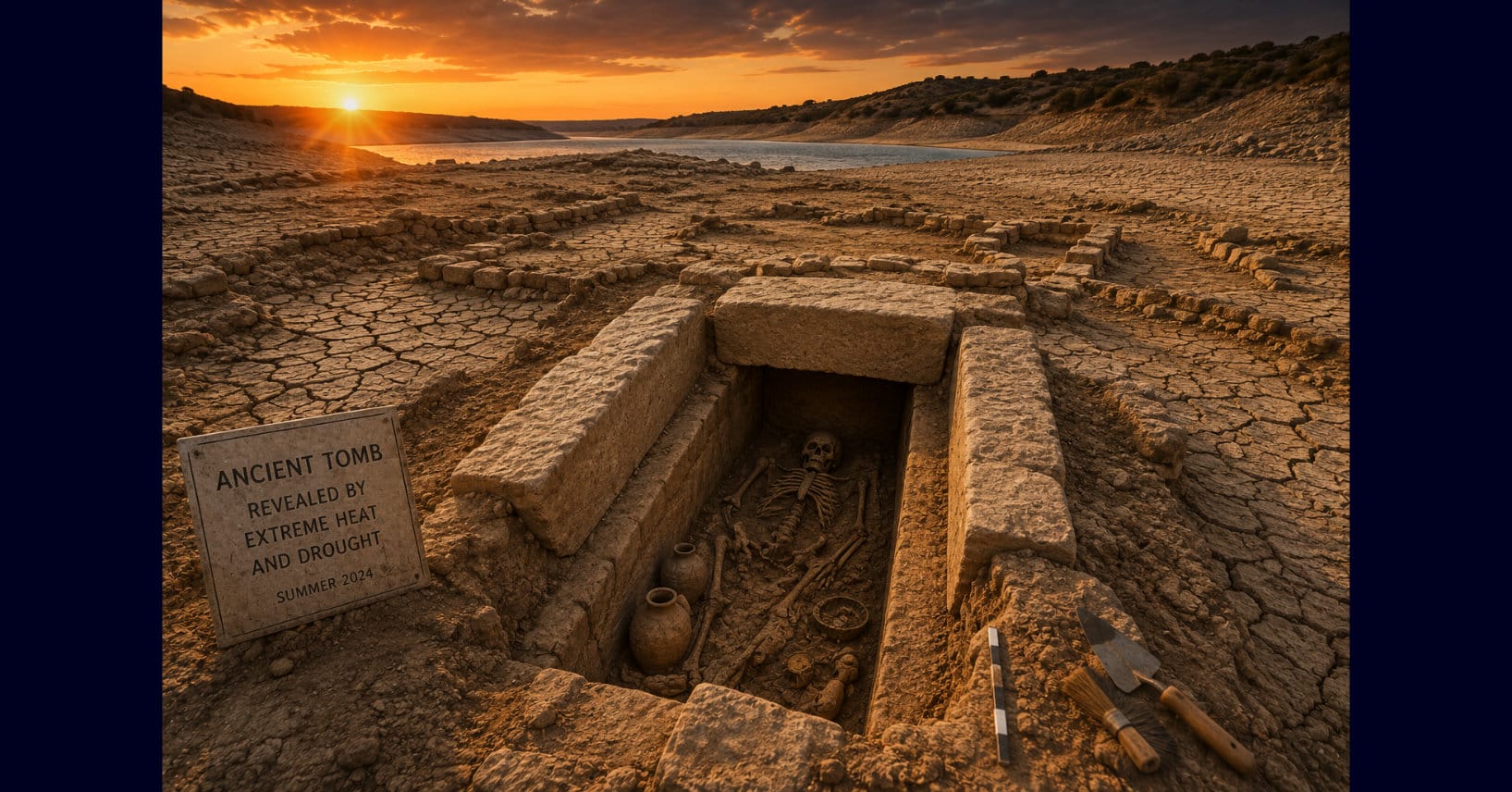
Extreme heat, drought, and receding water can expose archaeological sites that have remained concealed beneath soil, vegetation, ice, or water for centuries. The Tomb the Heatwave Revealed examines how changing environmental conditions can uncover ancient burials and forgotten settlements while simultaneously placing them at risk of destruction. The article explores what tombs reveal about ancient communities and their beliefs about death, why unexpected discoveries often attract lost-civilization and ancient-alien speculation, and why Christians can welcome surprising archaeological evidence without allowing unanswered questions to become extraordinary conclusions unsupported by evidence.
Sometimes archaeology begins with a shovel.
Sometimes it begins with a drought.
And sometimes history reappears because the weather becomes extreme enough to expose what the landscape has concealed for centuries.
During unusually hot, dry conditions in Europe, falling water levels and parched ground have revealed archaeological features normally hidden beneath soil, vegetation, or water. Among the discoveries to emerge from such conditions are ancient settlements, roads, foundations, burial sites, and monuments whose outlines become visible only when the environment changes.
One recent discovery is especially compelling: an ancient tomb exposed after extreme heat and receding water altered the landscape that had protected it.
The heatwave did not create the archaeology.
It removed the veil.
And what appeared beneath it reminds us of something easily forgotten in an age of satellite imaging, ground-penetrating radar, LiDAR, and genetic analysis.
There is still an enormous amount of human history beneath our feet.
When the Landscape Becomes an Archaeologist
Archaeologists have long used environmental conditions to locate buried structures.
During drought, vegetation growing above ancient walls may respond differently from vegetation above former ditches or pits. From the air, these differences can create crop marks revealing buildings, enclosures, roads, and other structures invisible at ground level.
Falling reservoir and river levels can produce something even more dramatic.
The archaeology itself emerges.
Stone walls appear.
Foundations break the surface.
Burials become exposed.
Objects that remained submerged or protected beneath sediment suddenly encounter sunlight and air.
For archaeologists, these moments create both opportunity and urgency.
Exposure can make a site discoverable.
It can also begin destroying it.
Materials preserved for centuries in stable conditions may deteriorate rapidly once exposed to heat, oxygen, erosion, visitors, or changing moisture levels.
A newly revealed tomb therefore becomes a race against time.
Researchers must document what nature has uncovered before nature destroys it.
A Grave Without Its Story
A tomb is different from many archaeological discoveries because it immediately raises questions about a person.
Who was buried there?
When did they live?
How did they die?
What community placed them there?
Why was this location chosen?
What did the objects buried alongside them mean?
And what did those people believe happened after death?
A wall tells us people built.
A road tells us people traveled.
A tomb tells us people remembered.
Even before researchers identify the individual, the existence of a deliberate burial says something important about the people responsible for it.
Someone died.
Someone else cared what happened to the body.
Someone prepared a place.
Someone participated in a ritual.
Someone remembered.
The archaeology of death is therefore also the archaeology of belief.
When Mystery Rushes Ahead of Evidence
That makes tomb discoveries especially vulnerable to sensationalism.
A burial appears unexpectedly.
Its occupant is unidentified.
Artifacts seem unusual.
The site does not immediately fit an established interpretation.
And almost immediately, speculation begins.
Was this an unknown ruler?
A priest?
A warrior?
A member of a forgotten civilization?
Could the burial belong to a people history has overlooked?
Could unusual physical characteristics reveal an unknown ancestry?
The questions are legitimate.
The problem begins when questions quietly become conclusions.
This pattern appears repeatedly in ancient-mystery culture.
Archaeological uncertainty creates an empty space.
Then someone fills it.
Lost civilizations.
Giants.
Forbidden history.
Ancient technology.
Extraterrestrial visitors.
The less that is known, paradoxically, the more confidently some people seem to know what happened.
The Lost-Civilization Temptation
The possibility that entire settlements, burial grounds, and monuments remain undiscovered should make us humble about our knowledge of the past.
Archaeology is incomplete.
New discoveries genuinely can alter historical understanding.
Previously unknown cultures can be identified.
Migration patterns can be revised.
Chronologies can change.
Ancient DNA can reveal relationships no written source preserved.
That does not mean conventional history is collapsing every time something unexpected emerges from the ground.
Nor does it mean archaeologists are concealing an alternative civilization.
It means archaeology is working.
Science advances because new evidence changes what researchers know.
That distinction matters when discussing lost civilizations.
There are unquestionably civilizations, communities, and populations whose histories remain poorly understood.
But “unknown to us” does not mean “technologically superior to everything known.”
And “lost” does not mean extraterrestrial.
Ancient People Were Already Extraordinary
One reason ancient-alien theories remain persuasive is that modern people routinely underestimate ancient humanity.
We see monumental architecture and wonder how people without modern machinery could have constructed it.
We encounter astronomical alignments and assume sophisticated observation must have required outside instruction.
We discover advanced craftsmanship and imagine knowledge arriving from somewhere else.
But the biblical picture of humanity never requires us to imagine early people as intellectually incapable.
Genesis presents civilization developing rapidly.
People build cities.
They cultivate land.
They raise livestock.
They create musical instruments.
They work metals.
Human ingenuity appears very early because human beings bear the image of their Creator.
“So God created man in his own image, in the image of God created he him;”
—Genesis 1:27, KJV
The ancient world does not become less remarkable when we credit human beings for what they accomplished.
It becomes more remarkable.
The Dead Still Ask the Same Question
There is also something deeply theological about a tomb revealed by changing weather.
Civilizations differ dramatically in how they understand death.
Some buried possessions with the dead.
Some constructed monumental tombs.
Some cremated bodies.
Some preserved them.
Some oriented burials according to religious or astronomical significance.
Some believed ancestors remained involved with the living.
Others anticipated judgment, reincarnation, an underworld, resurrection, or another form of continued existence.
The rituals differ.
The question does not.
What happens when we die?
Every tomb is evidence that someone confronted that question.
Christianity does not answer it through archaeological speculation.
Scripture declares:
“And as it is appointed unto men once to die, but after this the judgment:”
—Hebrews 9:27, KJV
The tomb may tell us what ancient people believed about death.
It cannot determine what is true about death.
That distinction is essential.
Climate Change and the Archaeological Record
There is another dimension to discoveries produced by extreme weather.
Changing environmental conditions may reveal more archaeology in the years ahead.
Droughts can expose crop marks.
Wildfires can remove vegetation covering ancient structures.
Melting ice can release artifacts preserved for centuries.
Retreating glaciers can uncover human remains.
Falling water levels can expose submerged settlements, bridges, roads, and graves.
Coastline erosion can reveal archaeological layers while simultaneously destroying them.
The paradox is striking.
Environmental change can increase archaeological discovery while accelerating archaeological loss.
Some sites may become visible only briefly.
Researchers may have months—or days—to study evidence that remained protected for thousands of years.
We may therefore be entering a period when pieces of the ancient world appear with increasing frequency.
That will produce genuine discoveries.
It will also produce sensational claims.
Discernment will matter.
Suppose Something Truly Unexpected Appears
Christians should not fear an archaeological discovery simply because it challenges an existing historical assumption.
Suppose researchers uncover a civilization older than expected.
Study it.
Suppose ancient DNA reveals an unexpected population migration.
Follow the evidence.
Suppose artifacts demonstrate technological abilities previously unknown for that culture.
Revise the history.
Truth does not become dangerous because it surprises us.
But neither should surprise become permission to abandon evidentiary discipline.
An unexplained artifact is unexplained.
An unidentified population is unidentified.
An unexpectedly sophisticated technology is unexpectedly sophisticated.
None of those statements contains the word extraterrestrial.
That conclusion requires evidence of its own.
The Heatwave Removed the Cover
For centuries, the tomb remained where its builders left it.
Generations lived and died above or around it.
Governments changed.
Borders moved.
Religions spread.
Languages evolved.
Modern civilization arrived.
Still the grave remained hidden.
Then the environment changed.
Water withdrew.
Earth dried.
And history appeared.
There is something almost poetic about that.
We often speak as though the ancient past has disappeared.
It has not.
Much of it is still here.
Under fields.
Beneath cities.
Inside caves.
Below reservoirs.
Frozen into ice.
Buried beneath deserts.
Waiting.
The tomb revealed by the heatwave does not prove a lost super-civilization.
It does not reveal extraterrestrial intervention.
It does not rewrite human origins.
But it does remind us how incomplete our knowledge remains.
That should produce neither credulity nor fear.
It should produce humility.
Because sometimes the difference between forgotten history and archaeological discovery is nothing more than a few feet of water.
And sometimes all it takes for the past to return is for the landscape covering it to disappear.