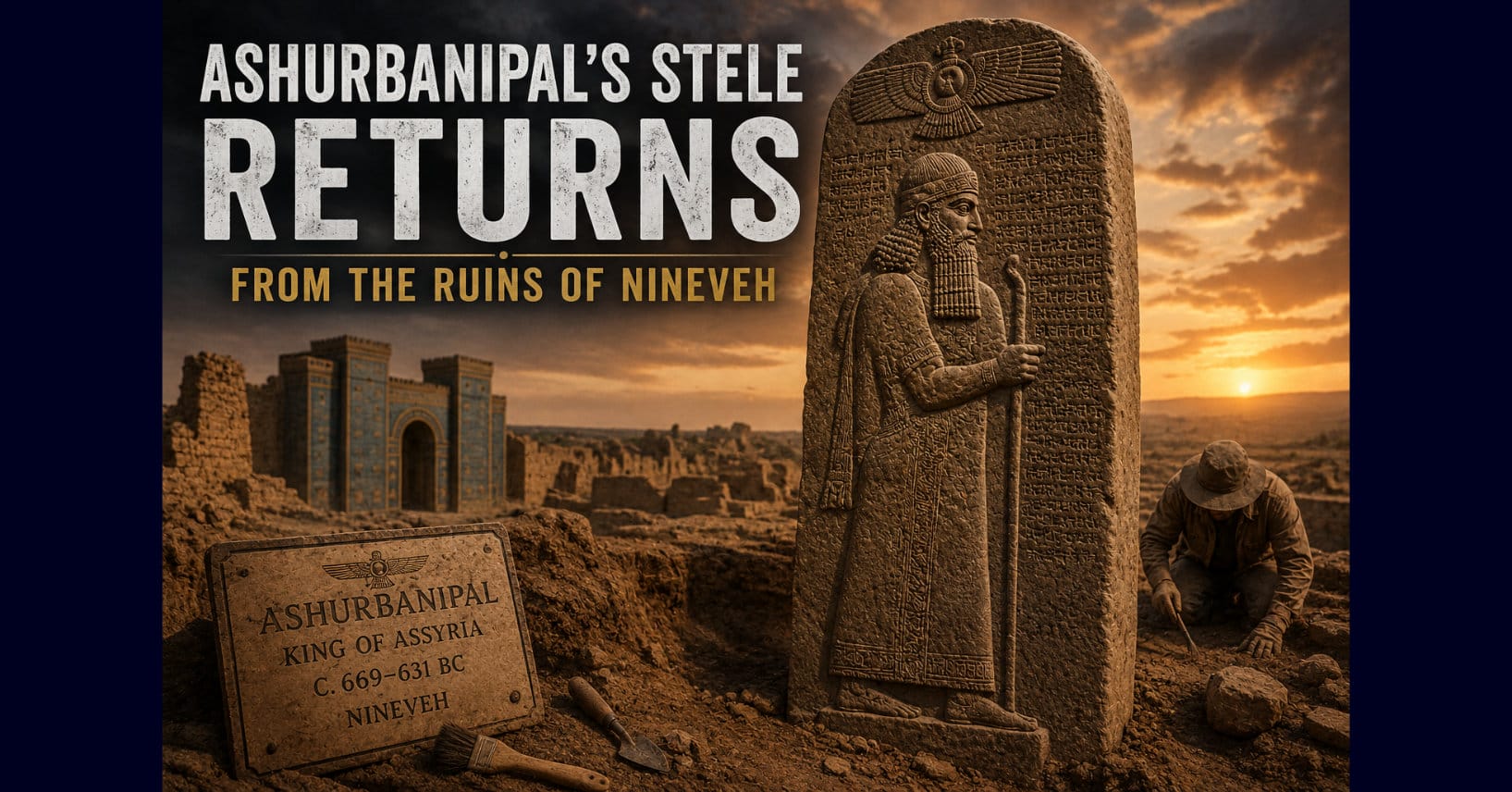
Archaeologists at ancient Nineveh have uncovered a monumental stone stele depicting Ashurbanipal, one of the Neo-Assyrian Empire’s most powerful kings. Ashurbanipal’s Stele Returns from the Ruins of Nineveh explores the discovery within the biblical and historical world of Assyria, from Nineveh’s prominence in Jonah and Nahum to Ashurbanipal’s famous library. The article also examines how Mesopotamian religion and technological achievements are frequently repackaged by ancient-alien theories, arguing that archaeology reveals sophisticated human civilizations without requiring extraterrestrial teachers. Ultimately, the recovered monument offers a striking reminder: kings and empires disappear, but the stones they leave behind testify to the impermanence of human power.
For more than 2,600 years, the image of one of the ancient world’s most powerful kings lay buried beneath the ruins of Nineveh.
Now it has emerged again.
Archaeologists excavating the ancient Assyrian capital have uncovered a monumental stone stele depicting King Ashurbanipal, ruler of the Neo-Assyrian Empire from approximately 669 to 631 BC. The discovery comes from the area of the Temple of Ishtar at Nineveh, near modern Mosul in Iraq.
Ashurbanipal is hardly an obscure figure.
Under his reign, Assyria reached extraordinary heights of military, political, and cultural power. His empire stretched across much of the ancient Near East. His royal library at Nineveh preserved thousands of cuneiform tablets, including literary, administrative, religious, scientific, and historical texts that would become indispensable to modern understanding of Mesopotamia.
Yet the rediscovery of his monumental image is important for another reason.
Nineveh is not merely an archaeological site.
It is a biblical city.
And Ashurbanipal ruled an empire whose history intersects repeatedly with the world described in Scripture.
A King Returns to View
The newly discovered stele reportedly stood several meters high and depicts Ashurbanipal in monumental royal form.
Such monuments were not merely portraits.
Assyrian royal imagery communicated authority.
The king stood at the center of an imperial worldview in which military conquest, political dominion, religious devotion, and royal legitimacy were closely connected. Reliefs and inscriptions celebrated victories, displayed defeated enemies, recorded tribute, and presented Assyria’s rulers as men favored by their gods.
To the people who originally saw such a monument, its message would have been unmistakable:
Assyria was powerful.
Its king was powerful.
Its gods appeared powerful.
And resistance carried consequences.
Archaeology now allows us to stand before the remains of that message thousands of years after the empire that proclaimed it ceased to exist.
There is an irony in that.
Ashurbanipal once ruled from Nineveh.
Today archaeologists excavate him from it.
Nineveh Before Ashurbanipal
The biblical importance of Nineveh reaches back before Ashurbanipal’s reign.
The book of Jonah records God’s command:
“Arise, go to Nineveh, that great city, and cry against it; for their wickedness is come up before me.”
—Jonah 1:2, KJV
Jonah eventually preached there, and the city responded with repentance.
“And the people of Nineveh believed God, and proclaimed a fast, and put on sackcloth, from the greatest of them even to the least of them.”
—Jonah 3:5, KJV
Whatever one concludes about the precise chronology connecting Jonah with individual Assyrian rulers, Scripture’s theological point is unmistakable.
Nineveh’s greatness did not place it beyond God’s authority.
Neither did its wickedness place it beyond His mercy when its people repented.
But repentance in one generation does not guarantee faithfulness in another.
Assyria later became infamous for imperial brutality and eventually served as God’s instrument of judgment against the northern kingdom of Israel.
Then judgment came upon Assyria itself.
The City That Could Not Fall
At its height, Nineveh must have appeared extraordinarily secure.
It possessed massive walls, monumental gateways, palaces, temples, military power, wealth, and imperial prestige.
Assyrian kings had defeated nations across the Near East.
Their inscriptions spoke the language of dominance.
Their monuments were designed to make that dominance permanent in stone.
It wasn’t permanent.
Nineveh fell in 612 BC to forces led by the Babylonians and Medes.
The Assyrian Empire collapsed.
Its palaces burned.
Its monuments broke.
Its temples became ruins.
Eventually the city that had terrified nations became an archaeological site.
The prophet Nahum had pronounced judgment against Nineveh:
“The LORD is slow to anger, and great in power, and will not at all acquit the wicked.”
—Nahum 1:3, KJV
That gives Ashurbanipal’s recovered stele a significance no royal sculptor could have intended.
A monument designed to proclaim the permanence of human power has become evidence of its impermanence.
Archaeology and the Bible
Discoveries at places such as Nineveh frequently generate unnecessary arguments between archaeology and Scripture.
Some approach archaeology as though every excavation must prove the Bible.
Others assume that archaeology somehow threatens biblical faith whenever a discovery complicates an established historical reconstruction.
Neither approach is necessary.
Archaeology investigates the material remains of human history.
Scripture presents God’s revelation through history while making theological claims that pottery, walls, inscriptions, and human remains cannot independently adjudicate.
Yet archaeology can illuminate the world Scripture describes.
Nineveh existed.
Assyria existed.
Its kings existed.
Its military campaigns were real.
Its imperial ideology was real.
Its extraordinary wealth and brutality are documented outside the biblical text.
The biblical authors were writing within a recognizable ancient Near Eastern world—not an imaginary landscape populated by invented empires.
Every discovery from Nineveh gives us another window into that world.
Where the Ancient-Alien Story Enters
Nineveh and ancient Mesopotamia also occupy an important place in modern alternative-history culture.
The civilizations of Sumer, Akkad, Babylon, and Assyria are frequently pulled into ancient-astronaut narratives.
Their gods become extraterrestrials.
Their religious imagery becomes depictions of spacecraft or technological devices.
Their astronomical knowledge becomes evidence of instruction from advanced visitors.
Their monumental architecture becomes evidence that ancient humans possessed knowledge they supposedly could not have developed independently.
The pattern should now be familiar.
Archaeology discovers something extraordinary.
Modern audiences underestimate the people who created it.
The resulting gap becomes an invitation for extraterrestrials.
But Ashurbanipal’s world does not require aliens to make it remarkable.
The Assyrians built enormous cities.
They engineered irrigation systems.
They maintained imperial communications.
They developed sophisticated military organizations.
They produced extraordinary stone reliefs.
They collected and copied literature.
They observed the heavens.
They recorded knowledge on clay tablets.
Human beings did these things.
The Library Beneath the Ruins
Ashurbanipal’s greatest contribution to modern scholarship may not have been military at all.
It was his library.
Thousands of cuneiform tablets recovered from Nineveh preserved texts that might otherwise have disappeared entirely.
Among them were copies of the Epic of Gilgamesh, including its famous flood narrative.
That discovery inevitably generated questions about the relationship between Mesopotamian flood traditions and the Genesis account.
Those questions remain legitimate subjects of historical and textual scholarship.
But similarities between ancient traditions do not automatically establish that Scripture borrowed its theology from pagan mythology.
Nor do ancient Mesopotamian stories about beings descending from the heavens establish extraterrestrial visitation.
Ancient people interpreted the world religiously.
They told stories about gods.
They constructed temples.
They practiced divination.
They sought supernatural knowledge.
The spiritual dimension of ancient civilization should be taken seriously without converting every supernatural claim into a technological one.
That distinction lies at the heart of The Alien Deception Chronicles.
Gods From Heaven—or the Ancient Lie?
Modern ancient-alien interpretations often perform an unusual transformation.
They begin by rejecting ancient religion as mythology.
Then they reinterpret the mythology literally—but technologically.
The gods were not gods.
They were extraterrestrials.
The heavens were not spiritual.
They were outer space.
Divine vehicles were spacecraft.
Supernatural knowledge was advanced technology.
Creation stories were genetic engineering.
Suddenly ancient religion has not disappeared.
It has simply been given a scientific vocabulary.
For Christians, that should raise an important question.
What if ancient humanity’s spiritual encounters were genuinely spiritual—but the beings involved were not who people believed them to be?
Scripture presents a world containing both human and nonhuman intelligences.
But it never instructs us to reinterpret those beings as biological visitors from distant planets.
The modern extraterrestrial explanation may therefore obscure rather than illuminate the ancient world’s spiritual dimension.
The King and the Ruins
There is something fitting about Ashurbanipal’s image emerging from Nineveh now.
The king who once presided over one of history’s most formidable empires has returned not as a ruler but as an artifact.
His armies are gone.
His government is gone.
His palace is ruined.
The gods worshipped in his temples no longer command an empire.
The civilization that appeared immovable became layers of soil for archaeologists to excavate.
Yet the God proclaimed in Scripture remains.
That does not make Ashurbanipal’s stele unimportant.
It makes it more important.
The monument gives us another tangible connection to the world in which biblical history unfolded.
It reminds us that ancient civilizations were more sophisticated than we sometimes imagine.
And it warns us against using their achievements as excuses to invent extraterrestrial teachers when human ingenuity already provides an explanation.
Stones Outlive Kings
Ashurbanipal commissioned monuments because kings want to be remembered.
In one sense, he succeeded.
More than twenty-six centuries later, we are still speaking his name.
But not for the reason his sculptors intended.
His stele no longer intimidates conquered peoples.
It sits within the ruins of the civilization whose permanence it once proclaimed.
That may be the most powerful message the stone carries.
Empires rise.
Kings proclaim themselves mighty.
Civilizations build monuments to permanence.
And eventually someone digs them out of the ground.
Ashurbanipal’s stele has returned from the ruins of Nineveh.
It does not tell us that ancient humanity needed visitors from the stars.
It tells us something simultaneously simpler and more profound.
Human beings can build extraordinary civilizations.
They can accumulate extraordinary knowledge.
They can wield extraordinary power.
And none of it makes them permanent.
The stones may outlive the kings.
But they do not outlive God.