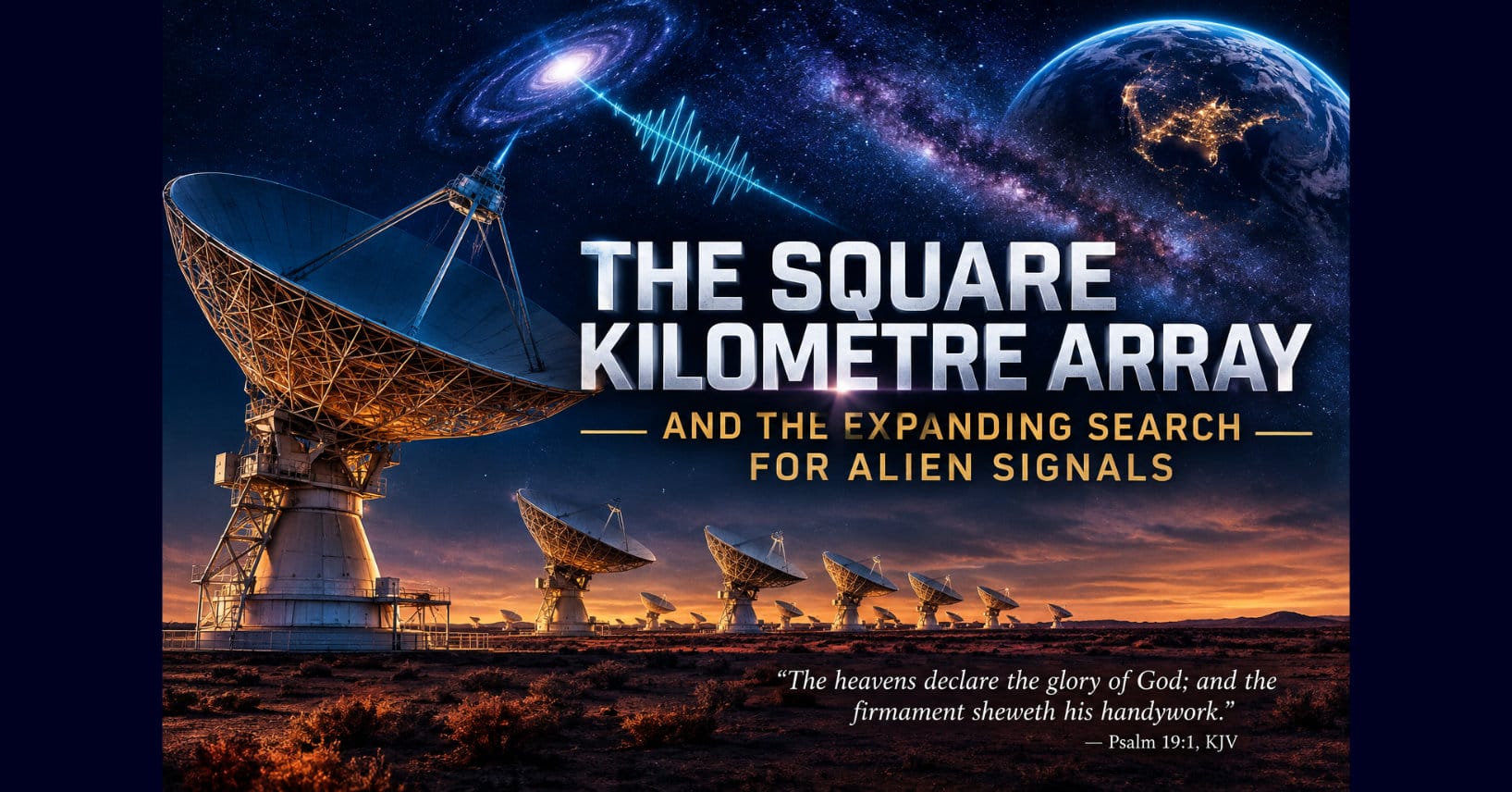
The Square Kilometre Array represents a major advance in radio astronomy, with enormous networks of antennas in Australia and South Africa designed to investigate some of the universe’s deepest scientific questions. Its capabilities could also dramatically expand the search for extraterrestrial technosignatures. The Square Kilometre Array and the Expanding Search for Alien Signals examines what a confirmed artificial signal would—and would not—establish, how scientific credibility could be transferred to unsupported spiritual claims, and why Christians must distinguish technological sophistication from spiritual authority if humanity ever receives a message from beyond Earth.
For most of human history, the stars were silent.
People could watch them move across the heavens, chart the planets, observe comets, and wonder whether anything—or anyone—existed beyond Earth. But there was no practical way to listen across interstellar distances for evidence of another technological civilization.
That changed with radio astronomy.
Now humanity is preparing to listen with instruments of unprecedented sensitivity.
The Square Kilometre Array, or SKA, is an enormous international radio astronomy project being constructed across sites in Australia and South Africa. Rather than operating as one giant dish, the observatory combines signals from vast networks of antennas spread across large distances, effectively creating instruments with extraordinary sensitivity and resolution.
Its primary scientific objectives extend far beyond extraterrestrial intelligence. Astronomers hope to use the SKA to investigate the early universe, galaxy formation, cosmic magnetism, pulsars, gravity, dark matter, and other fundamental questions.
But its capabilities also have obvious implications for one of humanity’s oldest modern questions:
Is anyone else transmitting?
Listening Deeper Into the Cosmos
The search for extraterrestrial intelligence—SETI—has historically faced a fundamental technological limitation.
Space is enormous.
Radio signals weaken dramatically with distance.
Potential civilizations could transmit across countless frequencies using methods we have not anticipated.
And even if another civilization were broadcasting, Earth would need to be listening in the correct direction, at the correct frequency, at the correct time.
The SKA changes part of that equation.
Its enormous collecting capability and wide observational reach could allow astronomers to conduct more sensitive searches for artificial radio emissions from nearby planetary systems. SETI researchers may be able to examine astronomical data for narrowband transmissions or other signals that appear inconsistent with known natural sources.
This does not mean the SKA was built primarily as an alien-detection machine.
It was not.
But an observatory capable of hearing the universe with unprecedented sensitivity inevitably expands humanity’s ability to search for technological signatures.
That makes the SKA scientifically exciting.
It also makes it culturally important.
What Would Count as an Alien Signal?
The phrase “alien signal” sounds much simpler than the science behind it.
Radio astronomy already detects extraordinary phenomena.
Pulsars once seemed so unusual that the first discovered signal was informally associated with the possibility of “little green men.” Fast radio bursts later generated their own extraterrestrial speculation before astronomers developed increasingly strong natural explanations for many of them.
The history contains an important lesson.
Unusual does not mean artificial.
Artificial does not automatically mean extraterrestrial.
And unexplained does not mean intelligent.
A candidate technosignature would require extensive verification.
Researchers would need to determine whether the signal came from terrestrial interference, satellites, spacecraft, instrumentation, natural astronomical phenomena, or another source.
Independent observatories would need to detect it.
Its location would need to be established.
Its characteristics would need to withstand repeated analysis.
The more extraordinary the interpretation, the stronger the evidence must become.
That discipline is precisely what Christians should want.
Truth does not need weak evidence.
The Day the Signal Arrives
But suppose something extraordinary happens.
Imagine that the SKA—or another observatory—detects a narrowband signal originating from a nearby star.
Other telescopes confirm it.
The signal repeats.
It contains unmistakable mathematical structure.
Natural explanations are eliminated.
Eventually scientists announce that the most plausible explanation is technological intelligence.
The cultural impact would be enormous.
But notice what would actually have been established.
A technological signal would demonstrate technology.
It would not tell us what the beings producing it look like.
It would not tell us whether they are benevolent.
It would not tell us whether their account of history is truthful.
It would not tell us whether they created humanity.
It would not tell us whether they visited ancient civilizations.
And it would not give them spiritual authority.
Those would all be separate claims.
That distinction could become one of the most important questions of discernment humanity ever faces.
From Scientific Discovery to Spiritual Authority
The potential danger lies not necessarily in detecting extraterrestrial intelligence.
It lies in what humanity might subsequently believe about it.
Modern culture has spent decades imagining technologically superior extraterrestrials as morally or spiritually superior beings.
Science fiction frequently portrays advanced civilizations as having transcended religion, warfare, greed, nationalism, or other human conflicts. New Age spirituality goes further, presenting extraterrestrial beings as enlightened teachers guiding humanity toward higher consciousness.
Starseed teachings already speak of Pleiadians, Arcturians, Sirians, and galactic councils.
Channelers claim to receive messages from them.
Ascension movements describe humanity as approaching a planetary transformation.
Now imagine what happens if radio astronomy confirms that technological intelligence exists somewhere beyond Earth.
Scientific evidence for one proposition could rapidly be used to validate dozens of unrelated spiritual claims.
Aliens exist.
Therefore perhaps the channelers really are communicating with them.
Perhaps starseeds really did incarnate from their civilizations.
Perhaps ancient religions really were misunderstandings of extraterrestrial contact.
Perhaps these beings really have been guiding humanity.
Perhaps they know who created us.
None of those conclusions follows from detecting a radio signal.
But culturally, the leap could happen almost overnight.
The Deception Would Borrow Scientific Credibility
This possibility sits directly within the speculative framework of The Alien Deception Chronicles.
The most convincing alien deception would not necessarily oppose science.
It could borrow science’s credibility.
Imagine the sequence.
Astronomers discover a confirmed technosignature.
Scientists establish that intelligent technological activity exists beyond Earth.
Years later, additional signals are detected.
Perhaps communication becomes possible.
Then comes information.
The senders explain who they are.
They describe humanity’s origins.
They reinterpret ancient history.
They explain religion.
They offer solutions to war, environmental crisis, disease, or human conflict.
At that point, an important transformation has occurred.
The scientific evidence established that a signal existed.
But the credibility earned by that discovery could transfer psychologically to everything the senders subsequently claim.
That transfer would be dangerous.
The ability to transmit across interstellar distances would establish technological sophistication.
It would not establish truthfulness.
Scripture Already Gives Us the Standard
Christians need not fear the possibility that life might exist elsewhere in creation.
Scripture does not require us to pretend we know things God has not revealed.
But Scripture does give us a standard for evaluating spiritual claims.
“Beloved, believe not every spirit, but try the spirits whether they are of God:”
—1 John 4:1, KJV
The principle is broader than ancient spiritual manifestations.
Claims must be tested.
Messengers must be tested.
Doctrine must be tested.
Extraordinary ability does not exempt anyone from examination.
If an intelligence from another world—or something claiming to be one—contradicted what God has revealed, Christians would face a choice.
Would we trust Scripture?
Or would technological spectacle become a new source of revelation?
That question may sound hypothetical today.
Projects such as the Square Kilometre Array make at least the scientific portion of the scenario less hypothetical than it once was.
Humanity is building better ears.
Listening Without Surrendering Discernment
The SKA represents an extraordinary achievement of human engineering and international scientific cooperation.
Christians should be able to appreciate that achievement without anxiety.
Study the universe.
Map the galaxies.
Listen to distant stars.
Investigate unusual signals.
If something extraordinary is discovered, examine it carefully.
God is not threatened by anything humanity discovers within the creation He made.
But neither should discovery become discipleship.
A signal from another star would be scientifically historic.
It would not become Scripture.
A civilization millions of years ahead of humanity technologically could still be wrong.
An intelligence capable of communicating across the galaxy could still deceive.
And beings possessing knowledge beyond our own would still be creatures—not the Creator.
The Square Kilometre Array may someday help answer whether technological intelligence exists beyond Earth.
If that day comes, humanity will face another question almost immediately.
Not simply:
Who is out there?
But:
What authority will we give them when they speak?
The first question belongs to astronomy.
The second belongs to discernment.