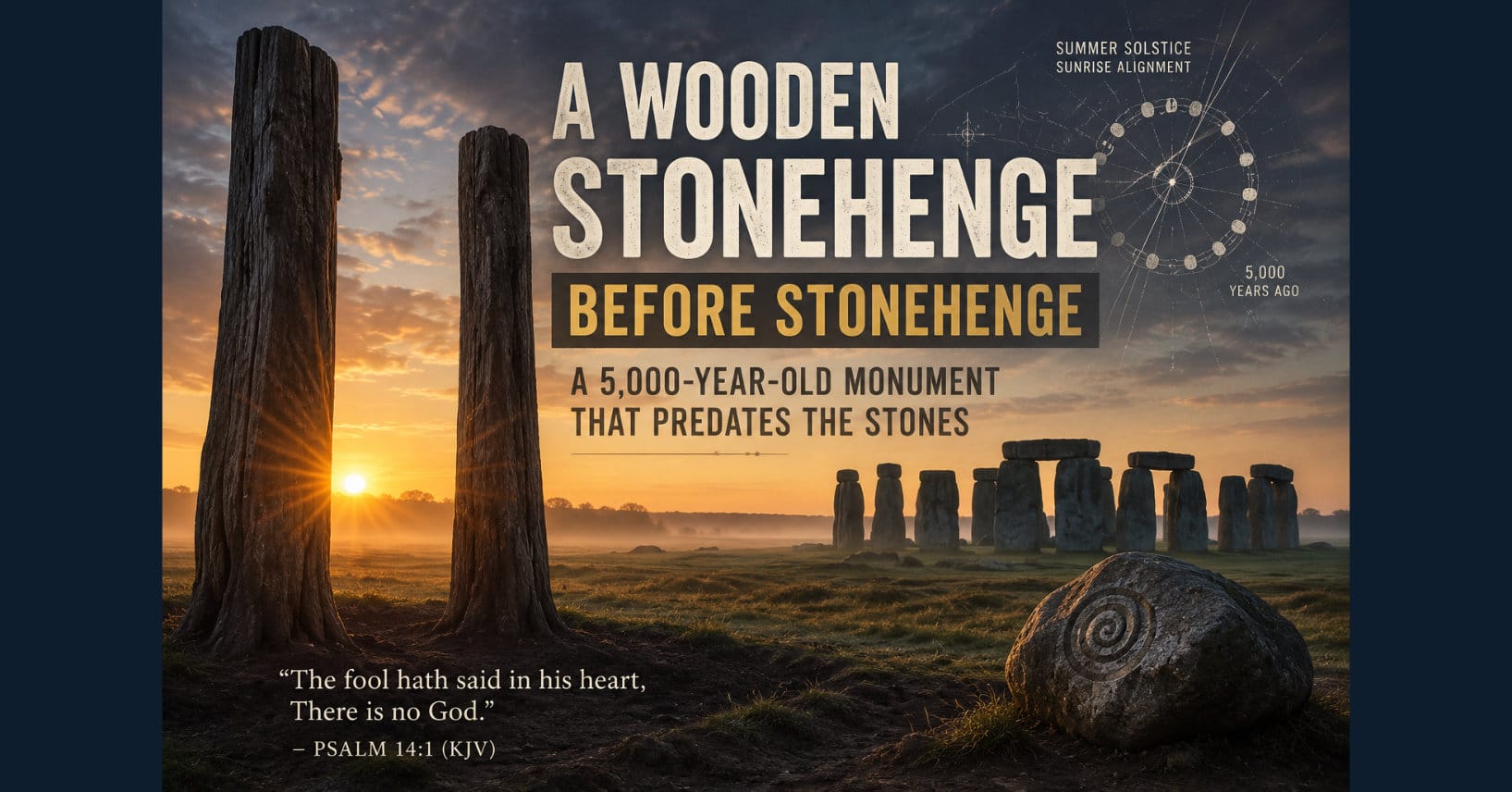
Archaeologists have identified a 5,000-year-old wooden monument near Stonehenge that appears to have been aligned with the summer solstice sunrise. The discovery suggests that ceremonial and astronomical practices in the region predated the stone circle and developed over time in a broader ritual landscape.
The post argues that such finds reflect human ingenuity rather than extraterrestrial or lost-civilization explanations. It presents a biblical view of ancient creativity and says the evidence expands knowledge of Britain’s prehistory without changing humanity’s origins.
For centuries, Stonehenge has stood as one of archaeology’s greatest mysteries. Its massive standing stones, astronomical alignments, and uncertain purpose have inspired countless theories ranging from sophisticated prehistoric engineering to extraterrestrial intervention. Every new discovery in the surrounding landscape seems to revive the same question: Who could have built such monuments?
A recent archaeological discovery has added another chapter to that story.
Researchers have identified a prehistoric wooden monument near Bulford on Salisbury Plain, only a few miles from Stonehenge. Dating to roughly 5,000 years ago, the site appears to have consisted of two enormous timber posts aligned with the summer solstice sunrise. The monument predates Stonehenge itself, suggesting that ceremonial and astronomical activity existed in the region centuries before the famous stone circle was constructed.
From an archaeological standpoint, the discovery is significant. It demonstrates that ancient communities developed increasingly sophisticated ritual landscapes over long periods rather than constructing Stonehenge in isolation. It also provides valuable insight into how prehistoric peoples observed celestial events and incorporated them into religious and ceremonial life.
Unfortunately, discoveries like this rarely remain within the boundaries of archaeology.
Almost immediately, they become fuel for speculative theories about lost civilizations, forgotten technologies, or extraterrestrial architects. Ancient monuments are frequently presented as evidence that early humanity lacked the knowledge to accomplish such feats on its own. If the construction appears impressive, some conclude that advanced visitors must have provided the necessary engineering or astronomical knowledge.
That conclusion does not follow the evidence.
The archaeological record consistently shows that human societies accumulated knowledge over generations. Monumental construction evolved through experimentation, observation, and cultural development. Ancient people were neither primitive nor unintelligent. They possessed remarkable engineering skills, mathematical understanding, and organizational ability long before modern technology existed.
The biblical worldview offers an even more compelling explanation.
Human beings were created in the image of God with the capacity for creativity, reasoning, craftsmanship, and innovation. After the Fall, those abilities remained, even as mankind increasingly directed them toward false worship. Throughout Scripture, people build cities, monuments, temples, towers, and altars. Human achievement has never required extraterrestrial assistance.
What it has often revealed is the human heart.
The new wooden monument reminds us that ancient civilizations looked to the heavens with profound religious significance. The question was never whether humanity sought meaning in the skies. It certainly did.
The question is where that search ultimately leads.
Throughout history, mankind has often exchanged worship of the Creator for fascination with the created order. Today, the same temptation appears in a different form. Rather than attributing ancient accomplishments to human ingenuity under God’s design, many seek explanations in cosmic visitors, hidden civilizations, or forgotten technologies.
This is precisely where discernment becomes essential.
Archaeology should inspire wonder. It should encourage careful investigation and respect for the achievements of those who came before us. But wonder should never become an invitation to abandon evidence in favor of mythology.
The discovery of a wooden predecessor to Stonehenge expands our understanding of Britain’s prehistoric past.
It does not rewrite humanity’s origins.
And it certainly does not require visitors from the stars.