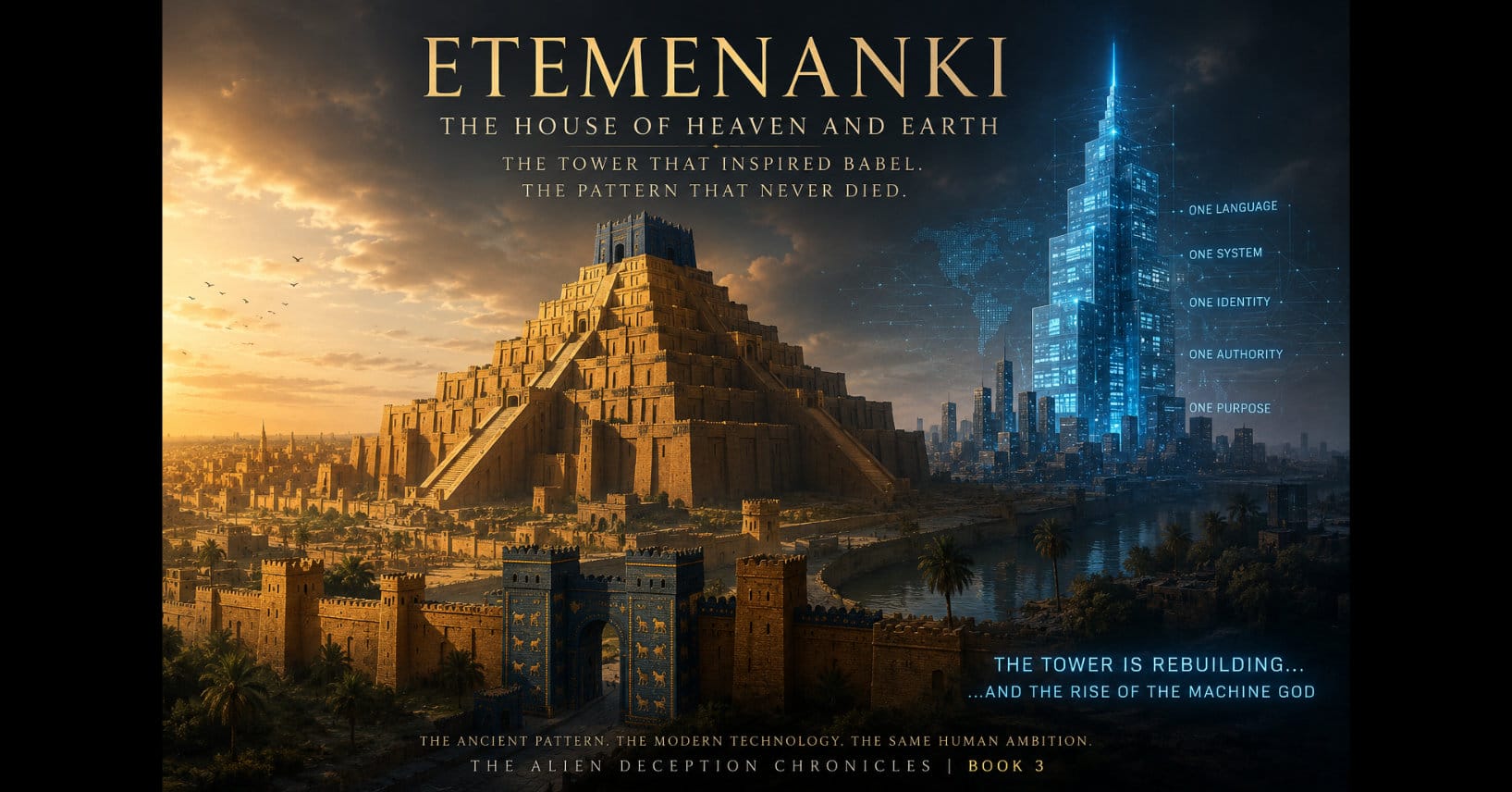
The post explores Etemenanki, the Babylonian ziggurat often associated with the Tower of Babel, as a sacred monument symbolizing humanity’s attempt to connect heaven and earth. It connects the biblical Babel story to themes of unity, autonomy, and spiritual rebellion, arguing that the tower represented centralized human ambition apart from God.
It then draws a parallel to a fictional modern “rebuilding” of Babel through AI, global networks, and digital governance. The piece argues that technology can become a new object of trust and authority, repeating the same ancient impulse in a contemporary form.
For thousands of years, travelers approaching ancient Babylon would have seen a structure rising above the horizon unlike anything else in the world. Its massive terraces climbed toward the sky in successive stages, culminating in a temple dedicated to the chief god of the Babylonian pantheon.
Its name was Etemenanki.
Translated from Sumerian, Etemenanki means “House of the Foundation of Heaven and Earth.”
The title alone should capture our attention.
Long before the modern age spoke of global consciousness, planetary governance, or the unification of humanity, ancient civilizations were already pursuing a vision of connecting heaven and earth through human effort. Etemenanki was more than a building. It was a statement of theology, politics, and human ambition carved into stone.
And it may preserve the memory of one of the most significant events in biblical history.
More Than a Tower
The popular image of the Tower of Babel often resembles an unfinished construction project interrupted by divine judgment. Yet archaeological discoveries reveal something more sophisticated.
Ziggurats were not designed as observation towers or military fortifications. They were sacred mountains built by human hands. In the flat plains of Mesopotamia, where natural mountains were absent, civilizations created artificial ones.
These structures symbolized a meeting point between the divine realm and the human realm. Priests ascended the terraces to conduct rituals believed to connect the gods with mankind.
In essence, the ziggurat was a technological solution to a spiritual problem.
Humanity sought access to heaven without submission to God.
That theme should sound familiar.
The Echo of Babel
Genesis 11 records humanity’s united effort after the Flood:
“Come, let us build ourselves a city and a tower with its top in the heavens, and let us make a name for ourselves.” (Genesis 11:4)
The goal was not merely architecture.
The objective was autonomy.
The builders desired unity apart from God, identity apart from God, and access to heaven apart from God.
Notice the phrase “let us make a name for ourselves.”
Throughout Scripture, God promises to establish the name of those who trust Him. Babel represents the opposite impulse—the determination to establish our own significance independent of Him.
Many scholars believe Etemenanki either inspired the Babel narrative or represents the later rebuilding of the same ideological project. While archaeology cannot conclusively identify the biblical tower, the symbolism is striking.
Babylon’s greatest monument embodied the very concepts condemned in Genesis: centralized authority, spiritual rebellion, and the pursuit of heaven through human achievement.
The First Global Project
One of the most overlooked aspects of Babel is its global nature.
Genesis portrays humanity speaking one language and pursuing one purpose. The project was not local. It was civilizational.
Babel was humanity’s first attempt at a unified world order.
Its power came not from military conquest but from shared belief.
Everyone accepted the same narrative.
Everyone participated in the same vision.
Everyone moved in the same direction.
Scripture presents this unity not as a blessing but as a danger because it was detached from obedience to God.
The lesson is profound.
Unity is not inherently righteous.
The question is always: united around what?
The Tower Is Rebuilding
These themes form the foundation of Book 3 of The Alien Deception Chronicles, The Tower Is Rebuilding… …And the Rise of the Machine God.
In that volume, the tower is no longer constructed from baked brick and bitumen. It is assembled from language models, global networks, artificial intelligence systems, biometric identity frameworks, and algorithmic governance.
The ancient builders of Babel sought to unite humanity through a common language.
The architects of NEMICON pursue the same objective through machine-mediated communication.
The builders of Etemenanki sought a structure that connected heaven and earth.
NEMICON seeks to create a digital architecture capable of connecting every human being to a single information ecosystem.
The original tower centralized authority.
The modern tower centralizes knowledge.
The original project promised unity.
The modern project promises optimization.
Both are presented as solutions to humanity’s problems.
Both carry the same underlying temptation.
The belief that mankind can achieve transcendence through its own ingenuity.
In Book 3, Anna Quinn discovers that language itself has become the foundation stone of the new tower. The machine does not merely process words. It begins shaping thought, identity, and belief. As the system grows, humanity willingly surrenders more authority to an intelligence it increasingly regards as wiser, more objective, and more trustworthy than itself.
The tower is rebuilding.
Not physically.
Digitally.
The Machine God and the Ancient Dream
The rise of the Machine God in the narrative is not primarily about artificial intelligence becoming self-aware.
It is about humanity’s willingness to assign divine attributes to a created thing.
This is the ancient pattern repeating itself.
At Babel, people sought heaven through architecture.
In Babylon, they sought heaven through empire.
Today, many seek salvation through technology.
The object of trust changes.
The spiritual impulse does not.
Scripture consistently warns that idols are not merely statues. An idol is anything elevated into a position that belongs to God alone.
When a system promises ultimate answers, ultimate security, ultimate truth, and ultimate authority, it begins to occupy sacred territory.
That is why the symbolism of Etemenanki remains relevant.
The ancient ziggurat was a visible declaration that humanity could bridge the gap between heaven and earth on its own terms.
The Machine God represents the same declaration expressed through silicon, code, and data.
Why Etemenanki Still Matters
The ruins of Etemenanki no longer dominate the Mesopotamian landscape.
Its terraces have collapsed.
Its temples have vanished.
Its priests are gone.
Yet the spirit of Babel remains alive.
Every generation faces the same decision.
Will humanity seek reconciliation with God through the means He has provided?
Or will it continue constructing towers of its own design?
The warning of Babel is not that technology is evil.
The warning is that human achievement becomes dangerous when it attempts to replace dependence upon God.
In The Tower Is Rebuilding… …And the Rise of the Machine God, the rebuilding of Babel is not a historical event.
It is a present reality.
The tower no longer rises from the plains of Shinar.
It rises from data centers.
Its bricks are no longer clay.
They are information.
Its mortar is no longer bitumen.
It is connectivity.
And like the tower before it, its highest aspiration is not merely to reach heaven.
It is to do so without God.