The post contrasts Norse Ragnarök with biblical end-times themes, emphasizing the Norse expectation of an inevitable final battle and the psychological effect of preparing for unavoidable destruction. It argues that end-times narratives shape how people interpret crisis, authority, and emerging power.
It then compares this framework with Scripture’s portrayal of an ordered end under God’s authority. The piece concludes that in moments of upheaval, discernment is crucial so people do not confuse inevitability with truth.
Some civilizations focused on beginnings.
Others focused on return.
The Norse focused on the end.
Not as a distant possibility—but as an unavoidable event.
Ragnarök.
A final battle.
A collapse of order.
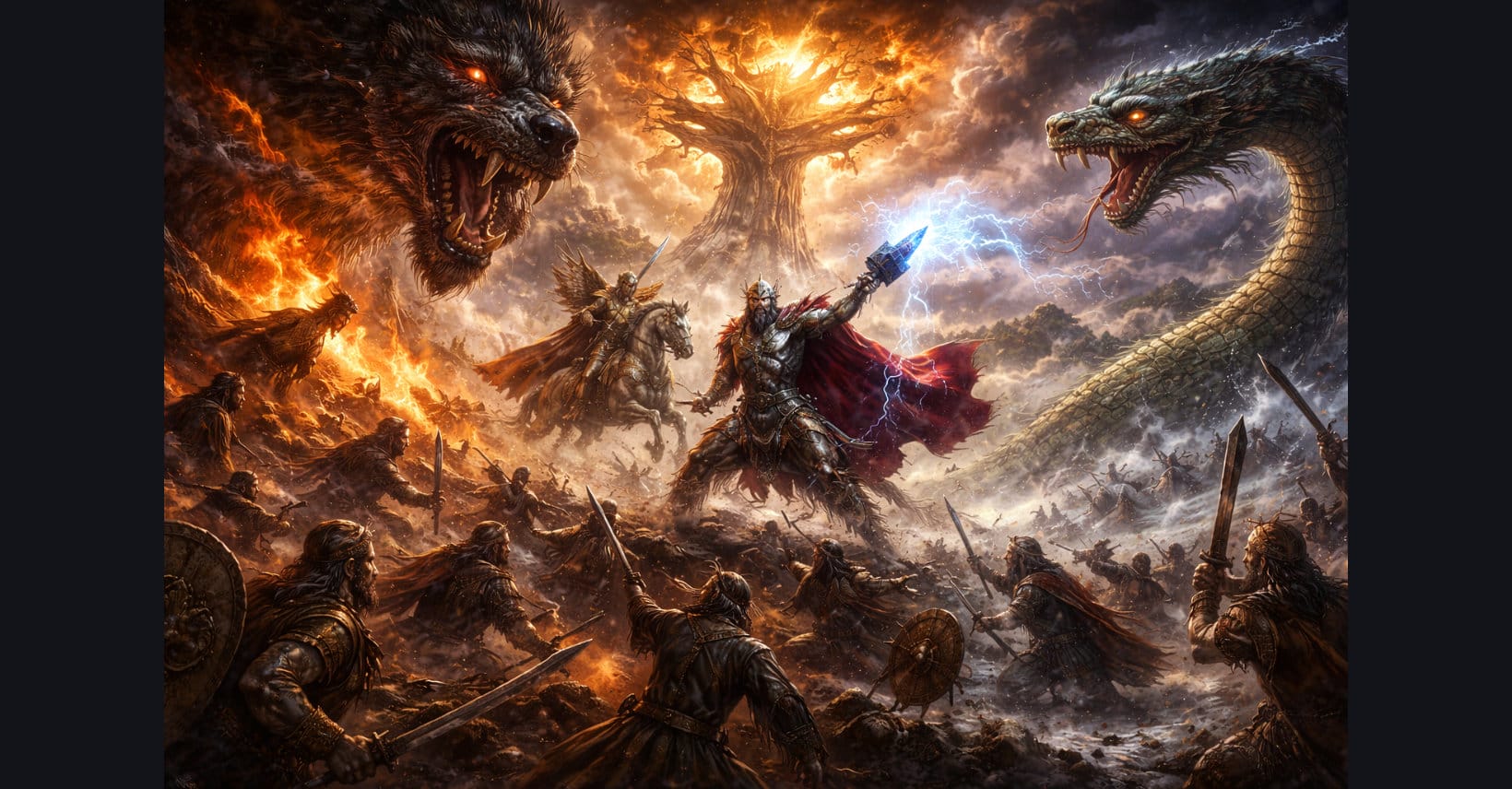
A confrontation between gods, giants, and forces that would bring the world as it was known to an end.
This was not speculation.
It was expectation.
A World Moving Toward an End
Norse cosmology is structured around tension.
The world is held together—for a time—but not indefinitely.
Gods like Odin and Thor are powerful, but they are not eternal in the same sense as an unchanging Creator. They exist within a system that is moving toward conflict.
Even the great world tree, Yggdrasil, is not untouched by decay.
Everything points forward.
Toward a moment when stability gives way to destruction.
The Certainty of Cataclysm
What makes the Norse tradition particularly striking is its certainty.
The end is not uncertain.
It is inevitable.
The gods themselves prepare for it.
They gather warriors.
They anticipate battle.
They move toward an outcome they cannot ultimately avoid.
This creates a unique psychological framework:
If destruction is certain, then preparation becomes focused not on prevention—but on participation.
Not on questioning.
On readiness.
The Role of Narrative in Crisis
A narrative about the end does more than describe the future.
It shapes how people respond to the present.
If a culture believes that chaos is coming, it may:
- Accept instability as normal
- Expect conflict as necessary
- Interpret disruption as part of a larger, unavoidable process
In that environment, events that might otherwise be questioned can be absorbed into the narrative.
Not resisted.
Understood as expected.
From the perspective explored throughout The Alien Deception Chronicles, this introduces another critical dimension:
Not only can humanity be shaped by beliefs about origin or return—
It can also be shaped by beliefs about how everything ends.
The Reinterpretation of Cataclysm
In the modern world, end-times narratives have not disappeared.
They have diversified.
Some are theological.
Some are scientific.
Some are speculative.
But many share common elements:
- A coming disruption
- A transformation of the world
- A transition into something new
In some cases, these narratives intersect with the idea of external intervention—advanced beings, guiding forces, or transformative events that reshape human existence.
Once again, the language changes.
But the structure remains.
The Question of Authority in the End
One of the most important aspects of any end-times narrative is this:
Who leads when everything changes?
If a moment of global disruption were to occur—whether through conflict, collapse, or extraordinary events—the need for guidance, stability, and authority would increase dramatically.
In that moment, the source of authority matters.
If something appears with the ability to:
- Explain the crisis
- Demonstrate power within it
- Offer direction through it
It will not be evaluated in a neutral environment.
It will be evaluated within the expectations people already hold.
If those expectations include the idea that powerful forces will emerge during a time of upheaval, acceptance becomes easier.
Scripture and the Nature of the End
The Bible also speaks of an end—but it does so with a fundamentally different foundation.
The outcome is not uncertain.
The authority is not shared.
And the resolution is not the result of competing forces struggling for dominance.
It is directed.
“And I saw a new heaven and a new earth…” (Revelation 21:1, KJV)
The contrast is significant.
The Norse tradition presents an end defined by conflict and loss—even among the gods.
Scripture presents an end defined by the authority of God and the fulfillment of His purposes.
A Future Reflection
If humanity enters a period of significant disruption, the question will not only be what is happening—
But how it is interpreted.
Is it random?
Is it inevitable?
Is it part of a larger plan?
And perhaps most importantly:
Who is understood to be in control?
Narratives like Ragnarök prepare people for a world where chaos is expected and survival depends on alignment with emerging power.
That expectation, once internalized, shapes response.
A Personal Reflection
What stands out in the Norse tradition is not just the scale of destruction.
It is the acceptance of it.
A worldview that does not resist the end—but moves toward it.
That mindset carries weight.
Because when people believe something is inevitable, they are less likely to question the forces that emerge within it.
And that is where discernment becomes most critical.
Not in moments of stability—
But in moments of upheaval.
Because it is in those moments that authority is often redefined.
And if that authority is accepted without examination,
the outcome may be shaped long before it is understood.
The question is not whether the world will face moments of crisis.
History suggests it will.
The question is whether, in those moments,
humanity will recognize the difference between inevitability…
and truth.