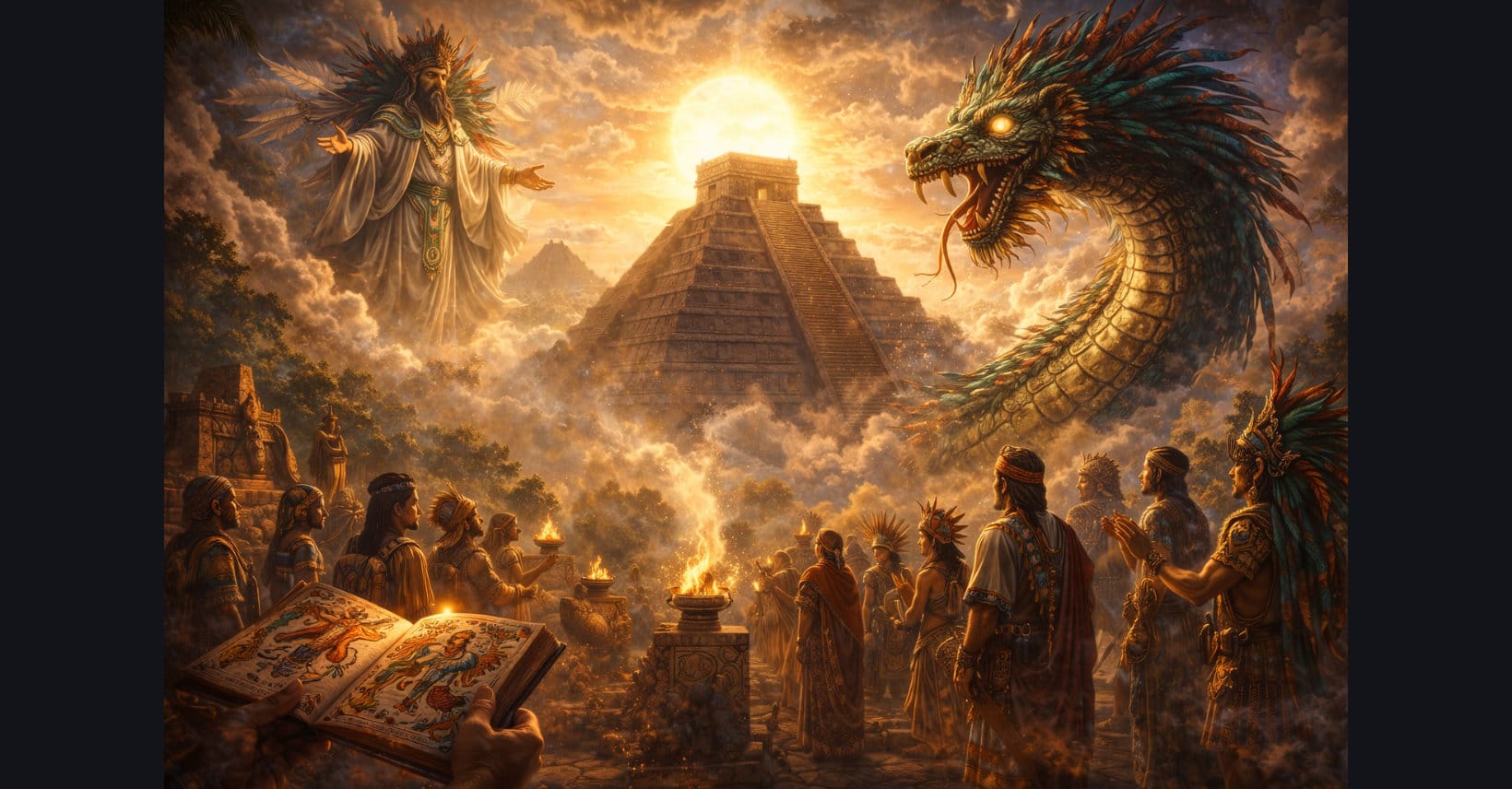
The post examines Mesoamerican traditions, especially the figure of Quetzalcoatl, as expressions of a recurring expectation that powerful beings will depart and return. It argues that this anticipation shaped how later events were interpreted, making unfamiliar arrivals easier to see as fulfillment of an existing belief.
It extends that pattern to modern ideas about advanced external beings and warns that expectation can override discernment. The piece emphasizes testing appearances carefully, since prepared beliefs may shape conclusions before events are fully understood.
There is a recurring idea embedded in the traditions of Mesoamerican civilizations that is both subtle and profound:
The gods are not gone.
They will return.
This belief appears in various forms across cultures such as the Maya and the Aztec, most notably in the figure often associated with the feathered serpent—Quetzalcoatl.
He is not merely a god of the past.
He is a presence tied to the future.
The Pattern of Departure and Return
In these traditions, the narrative follows a recognizable structure:
A powerful being arrives.
That being imparts knowledge, order, or structure.
Then the being departs—with the expectation of returning.
This pattern is not framed as myth alone.
It is framed as anticipation.
A future event embedded into cultural memory.
Temples, calendars, and ritual cycles reflect not only reverence for what was—but readiness for what may come again.
Expectation Shapes Interpretation
What makes this belief especially significant is not the story itself.
It is the expectation it creates.
Because expectation does something powerful:
It prepares perception.
When a culture is conditioned to believe that a specific kind of event will occur, it becomes more likely to interpret unfamiliar events through that lens.
History offers sobering examples of this dynamic.
Encounters with outsiders, unusual phenomena, or unexpected arrivals were sometimes interpreted not as unknowns—but as fulfillment.
Not questioned.
Recognized.
From the perspective developed throughout The Alien Deception Chronicles, this introduces a critical dimension to the broader pattern:
It is not enough for a narrative to exist.
It must be expected.
The Power of Preloaded Belief
A belief held in advance does not require immediate validation.
It requires alignment.
If something appears that resembles the expected pattern—even partially—it can be accepted quickly.
Because the groundwork has already been laid.
This is what makes the “returning god” motif so powerful.
It does not rely on proof in the moment.
It relies on preparation over time.
The mind does not ask, “Is this true?”
It asks, “Is this what we’ve been waiting for?”
The Modern Parallel
In the modern world, the language has changed—but the structure has not.
The expectation of returning gods has, in many circles, shifted into the expectation of returning or revealing advanced beings.
Not divine.
Not mythological.
But external.
Superior.
Arriving at a moment of significance.
Once again, the labels evolve.
But the anticipation remains.
And anticipation, once established, becomes a lens through which events are interpreted.
The Question of Discernment
Scripture consistently emphasizes the importance of testing what is seen and heard—not simply accepting it based on appearance or expectation.
Because expectation can be misleading.
If a population is prepared to believe that help, guidance, or authority will arrive from beyond humanity, then the arrival of something convincing—something powerful—may be accepted without sufficient examination.
This is not a theoretical concern.
It is a recurring pattern.
One that can be traced through multiple civilizations.
A Future Moment
Consider the possibility of an event that appears to align with long-held expectations:
A presence.
An arrival.
A demonstration of power or knowledge.
If that moment comes, the response will not be formed in isolation.
It will be shaped by what has already been believed.
By what has already been taught.
By what has already been anticipated.
This is one of the central themes explored throughout The Alien Deception Chronicles:
That humanity may not simply react to extraordinary events—
It may interpret them through narratives that have been building for centuries.
A Personal Reflection
What stands out in the Mesoamerican traditions is not just the reverence for the past.
It is the readiness for the future.
A civilization shaped not only by what it believed had happened…
But by what it believed would happen again.
That readiness carries weight.
Because it influences how reality is perceived when something unexpected appears.
And it raises a question that remains relevant today:
Are we interpreting events based on what is true…
Or based on what we have been prepared to expect?
Because when expectation leads interpretation,
discernment often follows behind.
And by then, the conclusion may already be set.