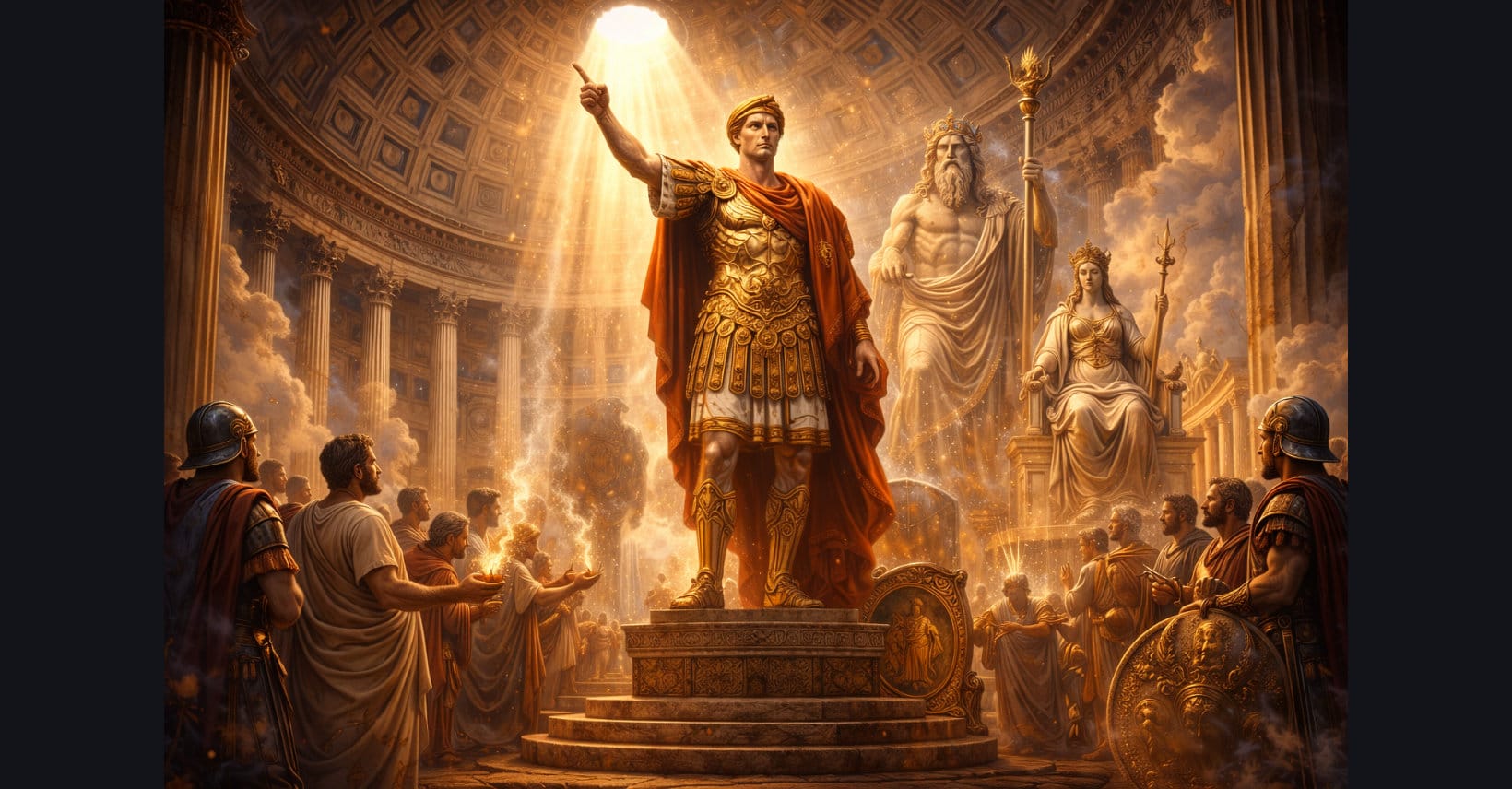
The post argues that Rome transformed religion into a structured system tied to the state, where temples, rituals, and public life reinforced civic loyalty. It highlights the imperial cult, in which emperors were treated as divinely sanctioned figures and participation signaled acceptance of their authority.
It then connects this model to a broader warning about how unified belief can legitimize power. The piece suggests that authority perceived as beyond human limitation can become difficult to challenge, creating an illusion of legitimacy that depends on public acceptance rather than proof.
Rome did not invent gods.
It organized them.
What began in earlier civilizations as stories, encounters, and interpretations became, in Rome, something more structured—something enforceable.
The divine was no longer only believed.
It was administered.
From Myth to Mechanism
Roman religion absorbed much of the Greek pantheon, renaming and reshaping it. Jupiter mirrored Zeus. Mars reflected Ares. Venus echoed Aphrodite.
But Rome introduced a decisive shift.
It fused the divine with the state.
Temples were not merely places of worship. They were instruments of civic life. Rituals were not only spiritual acts. They were public obligations tied to loyalty and identity.
And then came the turning point:
The emperor.
The Rise of the Imperial Cult
Roman emperors were not always declared gods during their lifetime—but they were treated as more than human.
Titles, honors, and rituals elevated them beyond ordinary authority. In many regions, especially throughout the provinces, emperors were openly worshiped.
Incense was burned in their name.
Oaths were sworn by their authority.
Images of the emperor stood in temples alongside traditional gods.
This was not symbolic.
It was systemic.
To participate in Roman society was to acknowledge the divine status of its ruler.
And to refuse… was not simply dissent.
It was defiance.
Authority Claimed, Not Proven
What makes this moment in history so significant is not merely that rulers claimed divine association.
It is that the claim became institutional truth.
No demonstration required.
No verification necessary.
Authority was declared divine—and reinforced through law, culture, and consequence.
From the perspective developed throughout The Alien Deception Chronicles, this represents a critical escalation in the pattern seen across earlier civilizations.
The supernatural was no longer interpreted.
It was assigned.
And once assigned, it became a mechanism of control.
The Power of Unified Belief
Rome understood something fundamental about human nature:
Belief, when unified, becomes force.
If an entire population accepts that authority is divinely sanctioned, then that authority becomes nearly unquestionable.
Not because it is true.
But because it is reinforced at every level:
- Cultural expectation
- Political structure
- Social participation
The result is a system where power is not only exercised—it is justified beyond challenge.
The Reframing in a Modern Context
Modern readers often view the Roman imperial cult as a relic of ancient thinking—an example of how far humanity has progressed.
But the underlying mechanism has not disappeared.
It has evolved.
The question is no longer whether a ruler is a god.
It is whether authority can be validated by something perceived as beyond human limitation.
If an individual or system were to demonstrate access to knowledge, power, or capability that appears non-human—whether technological or otherwise—the same dynamic could re-emerge.
Authority would not need to be earned in traditional ways.
It would be accepted.
Because it appears elevated.
The Illusion of Legitimacy
This is where the Roman model becomes especially instructive.
Divine authority, once institutionalized, creates an illusion of legitimacy that is difficult to challenge.
If power is believed to come from a higher source, then questioning that power feels like questioning the source itself.
And that is where discernment can break down.
Scripture consistently warns against this.
Not only against false gods—but against systems that claim authority they do not possess.
Because the danger is not always in obvious deception.
It is in convincing authority built on a false foundation.
A Future Reflection
If history shows anything, it is that humanity is capable of accepting extraordinary claims when those claims are presented within a structured system.
Rome provides the blueprint.
A unified narrative.
A centralized authority.
A reinforced belief system.
Now consider a future where authority is validated not by tradition, but by perceived access to something beyond humanity itself.
Knowledge.
Power.
Origin.
If those elements are presented convincingly, the question will not be:
“Is this authority legitimate?”
It will be:
“How do we align with it?”
A Personal Reflection
What stands out in Rome is not its power—but its precision.
A civilization that understood how to take belief and turn it into structure.
How to take reverence and turn it into requirement.
And how to take the idea of the divine…
and embed it into governance.
It is easy to look back and see the flaw.
Harder to recognize how similar patterns might appear in more refined forms.
Because the illusion of divine authority does not require ancient temples.
It requires only one thing:
A population willing to believe that power…
comes from somewhere beyond question.
And once that belief takes hold,
authority no longer needs to prove itself.
It only needs to be accepted.