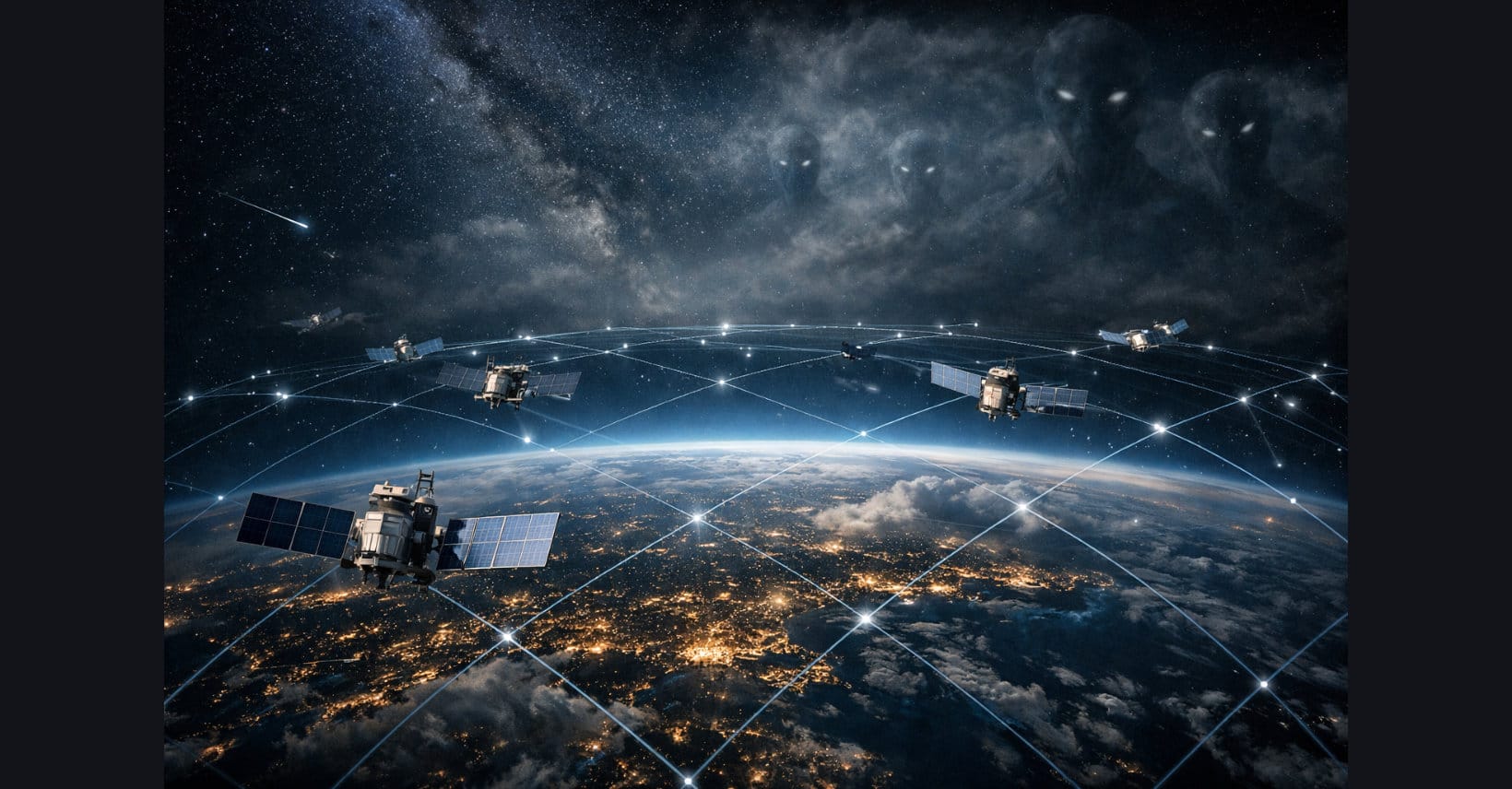
The post links Starlink’s global satellite network to biblical themes of “the power of the air,” Noah’s days, and the Watchers. It presents modern connectivity as a system that could support widespread influence, narrative control, and future deception.
Using speculative theology, it argues that technology itself is not evil, but that knowledge and coordination without spiritual grounding can mirror Babel and the corruption described in Genesis.
In the second volume of The Alien Deception Chronicles, ancient knowledge resurfaces beneath modern vocabulary. What Scripture calls “as it was in the days of Noah” (Matthew 24:37, KJV) becomes more than a prophetic echo. It becomes a pattern.
One of the most visually arresting technologies of our age is the satellite constellation deployed by Starlink, a project of SpaceX under the leadership of Elon Musk. Thousands of low-Earth-orbit satellites form a lattice around the globe, delivering high-speed internet to regions once disconnected.
From a purely engineering standpoint, it is remarkable. A planetary web. A digital firmament.
But in Book 2, the theological lens asks a deeper question: What does it mean for humanity to saturate “the power of the air”?
The Apostle Paul describes Satan as “the prince of the power of the air” (Ephesians 2:2, KJV). In the ancient world, air symbolized the unseen realm — influence without visibility. Today, the “air” carries our data, our speech, our markets, our media, our ideologies.
The Watchers motif in Book 2 explores Genesis 6 through speculative fiction: beings who descended with forbidden knowledge, accelerating civilization beyond moral readiness. In that narrative framework, technology is not evil. But knowledge without spiritual grounding becomes destabilizing.
Starlink symbolizes something profound:
- Total planetary connectivity
- Real-time global synchronization
- The removal of geographical isolation
- The infrastructure for unified narrative control
In the days of Noah, corruption became global. Not tribal. Not regional. Universal. Scripture says, “the earth also was corrupt before God, and the earth was filled with violence” (Genesis 6:11, KJV).
Book 2 asks: What happens when the infrastructure for global consensus already exists?
Satellite constellations do not create deception. But they enable scale. And scale changes everything.
A future deception — particularly one explaining mass disappearances or supernatural phenomena — would require instantaneous narrative coordination. A global sky network makes that plausible.
The theological speculation in Book 2 is not anti-technology. It is cautionary. It asks whether humanity is rebuilding Babel not with brick and slime, but with code and orbiting nodes.
Babel sought unity without God.
Modern systems achieve unity through bandwidth.
And the Watchers, in the story, understand something chilling: the airwaves are the new high places.