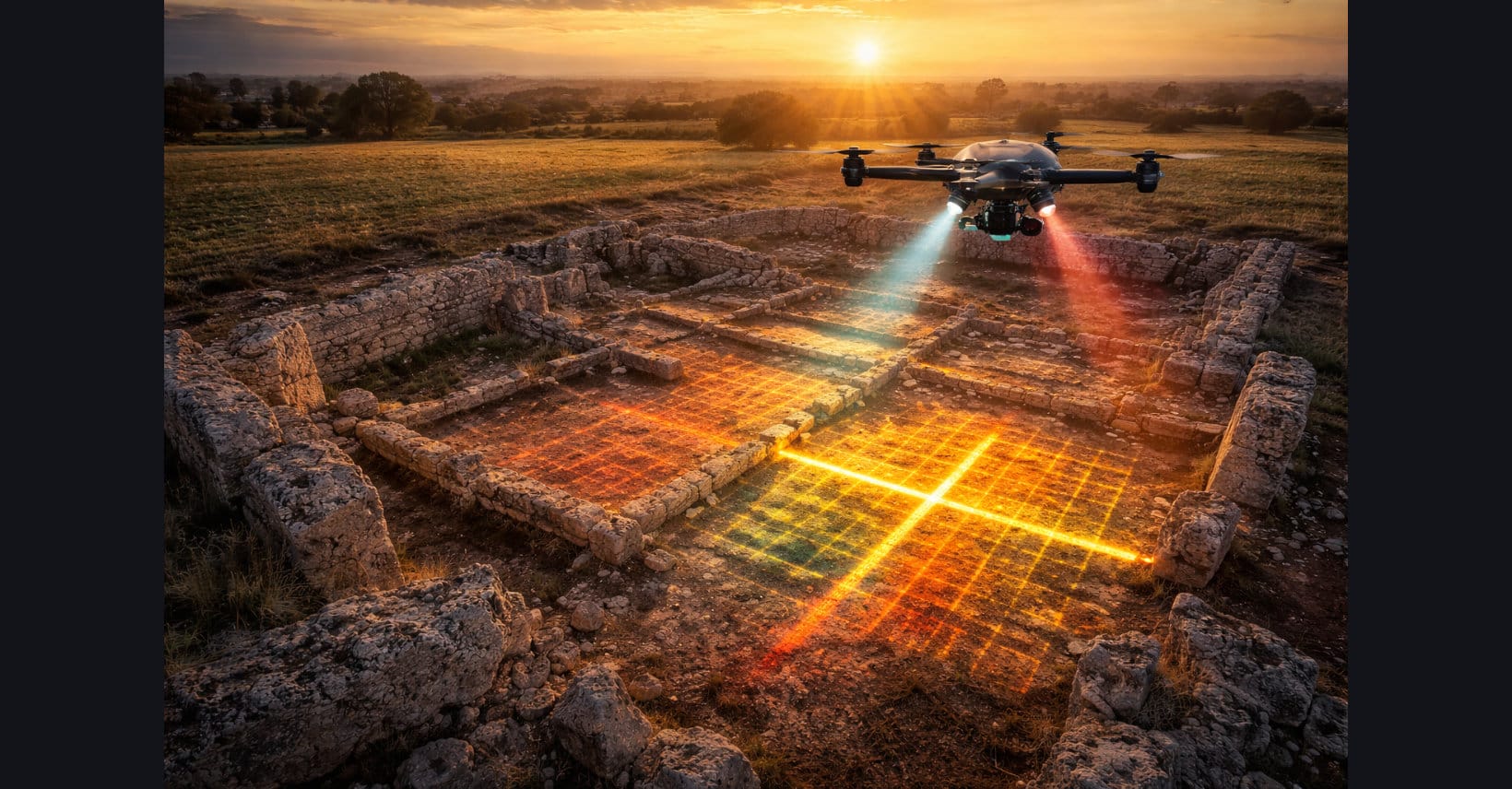
Archaeologists in southern Italy used drones with thermal and multispectral imaging to map a previously unknown ancient Roman city near the Via Appia. The survey revealed buried streets and monumental structures, including public forums and theaters, and suggests denser urban planning than previously recognized.
The discovery highlights how remote sensing can expose hidden archaeological remains and shape interpretation of patterned structures. It also notes that new technology can change what is seen as evidence of deliberate design versus what has simply gone unobserved.
In a striking demonstration of how modern sensing technology can resurrect lost worlds, archaeologists in southern Italy have discovered an entire previously unknown ancient Roman city near the historic Via Appia. Using advanced drone technology paired with thermal and multispectral imaging, researchers mapped a grid of streets and monumental structures that had lain buried for centuries.
The find revises our understanding of urban density and architectural planning in the Roman Republic and raises deeper questions about the intersection of technology, perception, and the remnants of ancient civilizations — themes central to The Alien Deception Chronicles. This city, once a hub of civic life with public forums and theaters, reflects a level of design precision that parallels the alignment and geometric intentionality seen in megalithic sites across the globe.
What makes this discovery particularly compelling for our broader narrative is the technology used to reveal it. The use of remote sensing to detect hidden orthogonal layouts beneath agricultural fields recalls the way advanced sensor arrays are now being deployed in sky surveys for unidentified aerial phenomena. In both cases, the unseen reveals itself through instrument‑enabled perception, challenging assumptions about what is truly “hidden” versus simply unobserved.
Moreover, the Roman grid’s clarity — its human‑designed precision — invites reflection on how order and pattern are detected, interpreted, and sometimes overstated in both archaeology and UAP research. The human tendency to ascribe intentional design or even exotic origins to unexpectedly ordered structures is a persistent theme in our work.
In this context, the rediscovered Roman city serves as an elegant reminder: technological tools expand the horizons of discovery, but they also shape our interpretations, which has direct implications for how we approach both ancient mysteries and contemporary anomalies